Best AI visibility tools and trackers (Oct 2026), with prices
Every serious AI visibility tracker, honestly compared - Profound, Peec, Otterly, Scrunch, AthenaHQ, Ahrefs, Semrush, SE Visible, HubSpot, BrightEdge and more. Entry prices checked in October 2026, the engines each covers, who it's for, pros and cons, and where it stops short. (We make one of them, and we say so.)
Muhammet İLBAŞ Updated 31 min read
A few years ago, "is my brand visible?" had one honest answer: check where you rank on Google. That answer is quietly going stale. A growing share of buyers now open ChatGPT, Perplexity or Gemini, type a question your product solves, and act on the two or three brands the model names - without ever seeing a results page. If you're not in that answer, the click you used to compete for never happens. A whole category of software has appeared to measure exactly this, and it is genuinely confusing: dozens of tools, heavy overlap, and a pile of listicles written by the vendors themselves. This is a longer, plainer field guide to that market.
Full disclosure before we go a step further: we make one of these tools - Zene. So treat our entry with the same skepticism you'd give any vendor writing about its own category, and judge everything below on the criteria, not on who's loudest. We've tried to describe competitors the way we'd want ours described: by what they actually do, who they fit, and where they stop.
This guide is long on purpose. AI visibility tooling is a fast, crowded, jargon-heavy market, and the short listicles tend to flatten real differences into a feature grid that hides what matters. So we're going to do the slow version: what the category is, why it appeared, how the engines differ, how to evaluate any tool, a tool-by-tool roundup with pros and cons, the build-vs-buy question, the red flags to watch in a sales demo, and what "working" actually looks like ninety days in. If you only want the prices, the table is right below. Skim the headings and jump to what you need. (Looking for AI writing tools or SEO suites instead? Those are different jobs, mapped in the best AI SEO tools in 2026.)
The best AI visibility tools at a glance (October 2026)
Every price below comes from the vendor's own pricing page, checked on October 4, 2026 for our side-by-side comparison pages - follow a tool's name for the full comparison and sources. BrightEdge, Evertune, Gauge, Nightwatch, ZipTie, Similarweb and Clearscope also appear in the roundup; we haven't re-checked their pricing, so we don't quote it.
Free forever: 1 brand, 10 questions, ChatGPT + Gemini, scans on demand, no card
Competitor prices as checked on October 4, 2026, from each vendor's public pricing page (sources on the linked comparison pages). Pricing in this category changes constantly - confirm on the vendor's page before you buy.
There is no page two in an AI answer. You are one of the two or three names in the sentence, or you don't exist.
Why this category exists at all
For twenty years, "being found" meant ranking in a list of blue links. The user saw ten options and chose. AI assistants quietly broke that model: they don't return a list, they return an answer - a paragraph that names a few brands and omits everyone else. There is no page two. There is no "scroll a bit further and you'll see us." You are either one of the two or three names in the sentence, or you are invisible, and the user never learns you existed. That's a categorically harsher distribution than search ever was, and it's why a new measurement discipline - usually called GEO, generative engine optimization - grew up almost overnight, with this tooling layer on top of it.
The behaviour shift is real and accelerating: people increasingly ask an assistant to compare, shortlist and even decide, and they trust the synthesised answer because it feels like advice rather than ads. We pulled together the numbers on that move in our AI search statistics roundup. The practical upshot for you is simple: a slice of demand that used to flow through Google now resolves inside a model's answer, unmeasured by any analytics you currently run - and you can't manage what you can't see. That blind spot is the whole reason to buy a tool in this guide.
What an AI visibility tracker actually does
Strip away the branding and nearly every tool in this guide does the same core loop. It takes a set of questions your buyers ask - "best CRM for a small agency," "Notion alternatives," "cheapest way to send invoices" - and runs them across one or more AI engines on a schedule. Then it parses each generated answer and records: were you mentioned, where in the answer, in what tone, alongside which competitors, and citing which sources. Do that every day across dozens of prompts and five engines and you get something that didn't exist before - a trend line for your presence inside AI answers, instead of a single anxious screenshot.
That's the whole job, and it's a real job: AI answers are non-deterministic and disagree across engines, so eyeballing ChatGPT once a week tells you almost nothing. But here is the single most important thing to understand before you pay anyone: most of these tools measure the problem; very few help you fix it. Tracking tells you you're missing from ChatGPT. It does not write the comparison page, earn the review, or unblock the crawler that's causing your absence. Keep that line in mind for every product below.
How to evaluate any tool on this list
Before the roundup, here are the questions that separate them. You can run any tool - including ours - through this grid and learn more than any feature table will tell you.
Engine coverage. ChatGPT-only is not enough; the engines behave differently and cite different sources. Look for the ones your buyers actually use: ChatGPT, Google's Gemini / AI Overviews, Perplexity, and ideally Claude and Grok too.
Data or direction? Does it hand you raw response logs and leave the thinking to you, or does it turn findings into a prioritised plan? Both are valid - just know which you're buying.
Competitors in frame. Your number in isolation is vanity. Share-of-voice against named rivals is where the insight lives - "you're named in 12% of answers, your competitor in 61%" is a strategy meeting; "you scored 34" is not.
Sources and citations. Does it show which domains the engines cite when they answer? That's the difference between knowing you're absent and knowing why - and where to go earn your way in.
Prompt realism and volume. A handful of prompts you typed yourself isn't a measurement; it's a vibe. Good tools help you build a representative, sizeable prompt set, suggest the questions worth tracking, and refresh it.
Sentiment and framing. Being named as "the cheap, limited option" isn't a win. Look for a tool that records how you're described, not just whether.
Crawler and technical visibility. Can the engines even reach and read your site? A tracker that flags a blocked bot or a JavaScript-only page saves you weeks of blaming your content.
Price against who you are. A solo founder and a 50-person brand team should not buy the same thing. Match the tier to the job, not to the longest feature list - and prefer vendors that publish their prices.
One honest caveat that applies to the whole category: AI answers vary run to run, so every tool here is sampling a moving target. Treat the numbers as directional trends, not gospel decimals - the tool that's transparent about its methodology and prompt counts is worth more than the one quoting you a suspiciously precise "visibility score" to two places.
The five engines, and why one tool can't fake coverage
It's tempting to think "I'll just track ChatGPT, that's where everyone is." That's the most common and most expensive mistake in this category, because the engines genuinely disagree with each other - they read different sources, weight them differently, and will happily recommend different brands for the identical question. Coverage isn't a checkbox; it's the difference between a measurement and an anecdote. Here's the shape of the five that matter.
ChatGPT (OpenAI) - the largest audience and the one most buyers picture. It blends trained knowledge with live web results, so both your reputation and your current pages matter.
Google Gemini / AI Overviews - enormous reach because it's wired into Search itself; leans heavily on what Google already trusts, which rewards classic authority and structured data.
Perplexity - the most citation-forward of the five. It shows its sources openly, which makes it the best window into which domains are feeding the answer, and a favourite of researchers.
Claude (Anthropic) - increasingly used inside work tools and assistants; conservative and reluctant to name brands it isn't confident about, so being clearly the best-evidenced option pays off.
Grok (xAI) - tied into a large social platform, with a different reading of what's current and talked-about; coverage here catches an audience the others miss.
Before you read fourteen tool reviews - see what the five engines say about you right now.
Type your brand name or domain - we'll line up the questions buyers ask about it.
The roundup
Loosely grouped by tier, each with what it's best at, honest pros and cons, and where it stops. Prices for tools we compare on /vs are the figures checked on October 4, 2026; for the rest we describe the product and leave pricing to the vendor's page. Inclusion here isn't an endorsement; it's a map.
Almost every tool here measures the problem beautifully. The question that actually separates them is whether anything tells you what to do about it.
1. Profound - the enterprise data platform
Profound is the name most people reach for when they say "category leader." Its pricing page lists nine engines - ChatGPT, Perplexity, AI Mode, Gemini, Copilot, DeepSeek, Claude, AI Overviews and Exa - and the product adds response-level detail, agents that draft and publish content, licensed prompt-volume data and agent analytics. It's built for organisations that want the richest possible picture and have someone to interpret it. Pricing is now sales-led: Custom Enterprise pricing after a 7-day trial (50 prompts, 3 engines); a third party reported that the earlier self-serve tiers were dropped in mid-September 2026, which matches the live page. Best for: large brands and data teams who want depth over hand-holding. More in Zene vs Profound.
Pros: the broadest feature set here; response-level detail; strong citation and competitor analysis; Google AI surfaces included; built for scale.
Cons: no published price or self-serve plan; a lot of platform to learn; Grok is no longer on its engine list.
2. BrightEdge - AI visibility bolted onto enterprise SEO
BrightEdge comes at the problem from the established enterprise-SEO direction. Its strength is entity and knowledge-graph alignment across large, multi-product content libraries - useful if you're a big organisation already living in an enterprise SEO platform and want AI visibility folded into the same workflow rather than bought as a separate point tool. Best for: enterprises that already run a heavyweight SEO suite and want one pane of glass. Watch-out: it's a lot of platform if AI visibility is your only question.
3. Peec AI - analytics depth for marketing teams
Peec AI is the fast-growing challenger, and its angle is competitive: how AI perceives your brand versus your rivals, with share-of-voice, sentiment and source reporting deep enough for agencies. It tracks six engines by default (ChatGPT, AI Overviews, AI Mode, Copilot, Perplexity, Gemini), with Claude and Grok as paid add-ons, and starts at $95/mo (50 prompts, 1 project, 3 of 6 models). Best for: marketing teams and agencies that think in competitive positioning. More in Zene vs Peec AI.
Pros: strong competitor and brand-perception framing; helpful suggested prompts; Google AI surfaces by default; clean trend reporting.
Cons: the entry plan covers 3 of its 6 default models; Claude and Grok cost extra; the fixing is still on you.
4. Otterly.AI - budget-friendly monitoring
Otterly is the popular "just let me track mentions without an enterprise commitment" option. It monitors brand mentions, links and citations on ChatGPT, AI Overviews, Perplexity and Copilot, with AI Mode, Gemini and Claude as add-ons, behind a clean interface, at Lite $29/mo ($25 yearly): 15 prompts, 1 workspace. It does the monitoring job honestly and doesn't pretend to be a strategy engine. Best for: small teams, freelancers and anyone validating "is this even a problem for us" before spending more. More in Zene vs Otterly.
Pros: a genuinely affordable entry point; easy to set up; covers Google's AI Overviews; great for a first real measurement.
Cons: monitoring-first, so the fixing is entirely on you; the entry plan's prompt count is small; several engines are add-ons.
5. Scrunch - brand presence plus what AI crawlers receive
Scrunch tracks eight engines and adds something most trackers don't: its Agent Experience Platform serves AI bots a clean, pre-rendered version of your pages. Sitecore announced it was acquiring Scrunch in June 2026, and it now also ships inside SitecoreAI. It's priced for mid-size and enterprise teams: $300/mo Starter ($250 billed annually; 350 custom prompts, 3 seats). Best for: mid-size and enterprise brands, especially Sitecore customers. Watch-out: it overlaps with several others here at a higher entry price, so trial before committing. More in Zene vs Scrunch.
6. Evertune - brand analysis at model scale
Evertune's pitch leans analytical: understanding how models represent your brand across many prompts and variations, aimed at brand teams who want a statistical read on AI perception rather than a feed of individual answers. It's more "research instrument" than "daily monitoring dashboard," which is a strength or a mismatch depending on what you need. Best for: brand and insights teams wanting aggregate perception analysis. Watch-out: can be more than a small team needs if you just want mention tracking.
7. Gauge - share-of-voice for AI answers
Gauge concentrates on measuring brand share-of-voice inside AI-generated answers and how it shifts over time. If the metric you care about most is "what slice of the relevant AI answers name us versus competitors," that focus is its appeal. As with the others in this band, weigh it on coverage and whether it shows you the citations behind the numbers. Best for: teams that want a clear share-of-voice headline metric. Watch-out: confirm engine coverage and source visibility match your needs.
8. Ahrefs Brand Radar - AI visibility inside a tool you may already pay for
Ahrefs added AI-answer tracking (Brand Radar) to its established SEO platform, so you see where your brand surfaces in AI Overviews, AI Mode, ChatGPT, Gemini, Perplexity and Copilot next to your familiar backlink and keyword data. It's sold per platform index: $199/mo per platform index ($699 all); Ahrefs' pages differ. Best for: existing Ahrefs customers who want AI visibility in the same place as their SEO. More in Zene vs Ahrefs Brand Radar.
Pros: benchmarking next to your SEO metrics; a huge underlying dataset; no extra vendor; Google's AI surfaces covered.
Cons: priced per engine index; an AI lens rather than a dedicated GEO workflow; Claude only on higher tiers.
9. Semrush AI Visibility Toolkit - AI visibility as part of the suite
Semrush has likewise extended its suite toward AI search visibility, tracking brand mentions and presence in AI answers next to its enormous body of traditional SEO and competitive data, at $99/mo per domain, 25 prompts (Sep 2026 snapshots). Same logic as Ahrefs: the value is integration and a single source of truth for both classic search and AI search, rather than a purpose-built GEO tool. Best for: existing Semrush teams who want AI tracking folded into reporting they already run. More in Zene vs Semrush.
Pros: integrated with the SEO data you already use; familiar interface; no new vendor.
Cons: AI features are one product among hundreds; a small prompt allowance per domain at entry; the value depends on already living in the suite.
10. HubSpot AEO and the free AI Search Grader
HubSpot's free AI Search Grader is a one-off scan: it estimates how often and how favourably engines mention your brand and gives you a snapshot report - a sensible zero-cost gut check. Since April 2026 HubSpot also sells a tracker, HubSpot AEO (built after its acquisition of XFunnel), which follows ChatGPT, Gemini and Perplexity at $50/mo ($45 billed annually), 25 prompts, standalone or bundled into Marketing Hub. Best for: the grader for a free first look; AEO for teams already running marketing in HubSpot. Watch-out: three engines, and 25 prompts on the entry plan. More in Zene vs HubSpot AEO.
11. Zene - tracking, plus what to actually do about it (our bias, stated plainly)
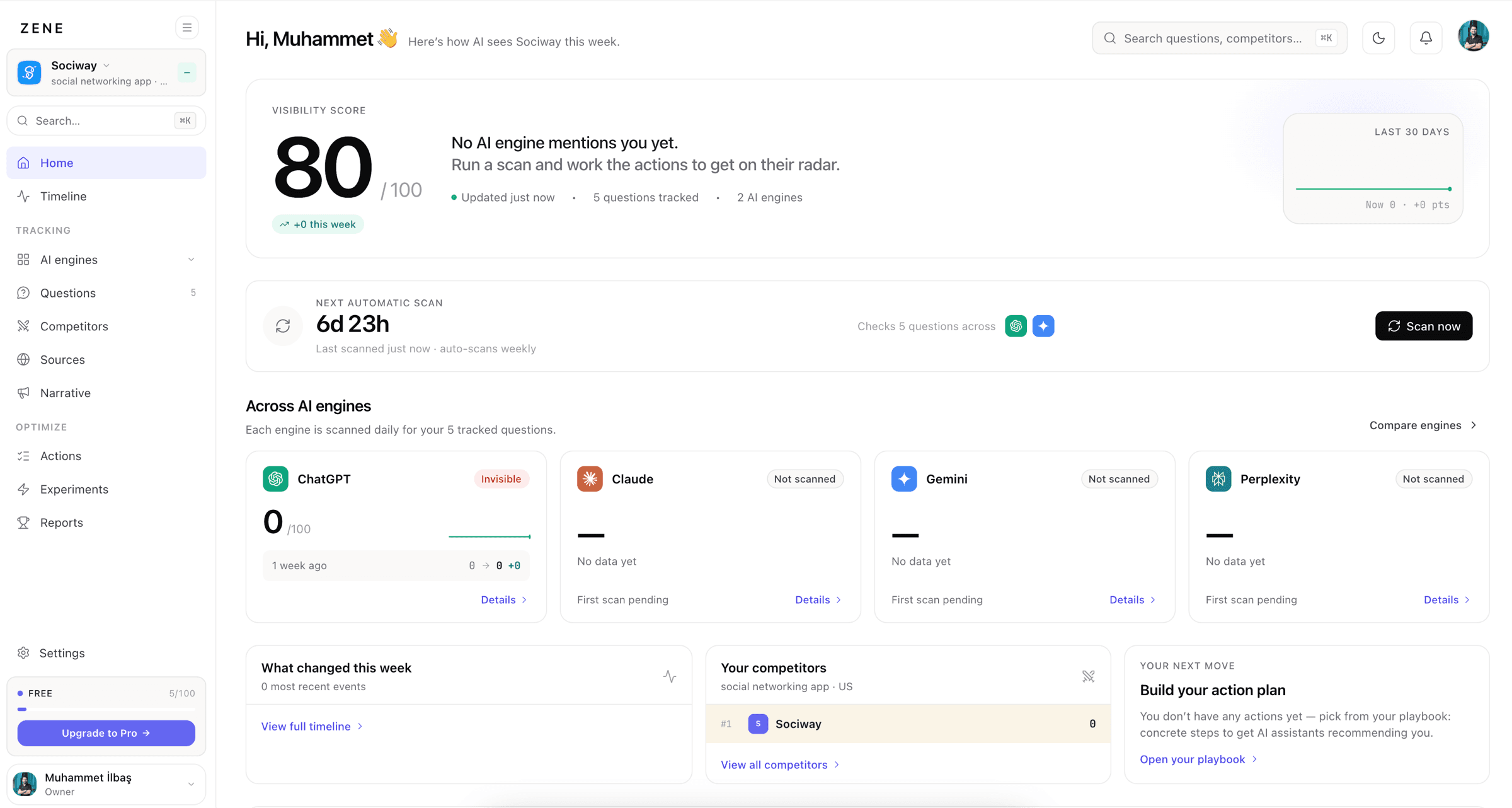
We built Zene around the gap that runs through this entire list: nearly everything above stops at measurement. Zene is an AI visibility tracker covering five engines - ChatGPT, Gemini, Perplexity, Claude and Grok - with competitors in the same frame and the cited sources exposed, and then it turns that into a prioritised action plan with drafts (content brief, FAQ, schema, llms.txt). So the output reads as "here's the single highest-leverage thing to fix next, and why," not just another chart. Pricing is public: Free, Pro $19/month, Growth $49/month, Agency $99/month ($190/$490/$990 yearly), in USD (see pricing). The free plan covers 1 brand and 10 questions on ChatGPT and Gemini, no card; Pro covers 2 brands and 15 questions shared across them on all five engines. We also ship a free AI visibility checker and an open-source readiness extension, so you can sample the approach before you pay anything.
Pros: five engines, competitors and citations together; converts findings into a ranked to-do list with drafts; a free plan that doesn't expire; published, flat pricing.
Cons: no Google AI Overviews or AI Mode tracking yet - if those are your main surface, Otterly, Peec or Ahrefs fit better today; smaller prompt allowances than the volume-first tools; newer than the incumbents. (And yes - this is the one we make, so weigh it accordingly.)
12. SE Visible (SE Ranking) - AI visibility from an affordable SEO suite
SE Visible is SE Ranking's standalone AI-visibility product. It tracks ChatGPT, Gemini, Perplexity and Google's AI Overviews and AI Mode daily, collected from real browser sessions, at $99/mo ($79.20 annual): 200 prompts, 3 projects. If you're a small agency or SMB already using SE Ranking for rank tracking and audits, it's the natural add. Best for: teams that want Google's AI surfaces and lots of prompts at a published price. Watch-out: Claude is listed as "coming soon" and Grok isn't tracked. More in Zene vs SE Visible.
13. Nightwatch - rank tracking that grew an AI view
Nightwatch is a long-standing rank tracker that extended into AI and answer-engine visibility, with a strength in granular, location-aware tracking. If you already track rankings across many locations and want AI presence in the same geographic frame, that heritage is the draw. Best for: teams with serious local/geo rank-tracking needs who want AI folded in. Watch-out: confirm how deep the AI-answer parsing goes versus its core rank tracking.
14. The new wave - LLMrefs, Knowatoa, AthenaHQ, Rankscale and friends
New dedicated GEO tools launch almost monthly, and several are worth knowing. LLMrefs sells one plan with a lot of prompts and seats ($79/mo single plan (500 prompts, unlimited projects and seats)). Knowatoa focuses on Google's AI surfaces at entry (Starter $59/mo (3 engines, unlimited brands; question count not disclosed)). AthenaHQ is the broad-coverage platform for larger teams, with a free plan and a paid entry of $295/mo Starter (3,600 credits, 11 engines). Rankscale is the power-user pick for wide engine coverage, MCP and an API (Essentials $204/yr ($17/mo, yearly only): 120 credits, 2 brand dashboards; Pro $99/mo: 1,200 credits). These move fast - features, pricing and even names change quarter to quarter - so run any of them through the evaluation grid above rather than trust a star rating. The grid is durable; the leaderboard isn't. Our comparison pages cover 23 of them with dated facts. Watch-out: the youngest tools carry the most roadmap risk - confirm engine coverage and data export before you depend on one.
15. Adjacent tools - ZipTie, Similarweb and Clearscope
Three more names come up in most roundups, each from a different direction. ZipTie leans into thorough analysis and client-ready reporting, which makes it a favourite of agencies and analysts who need to explain visibility to someone else - expect a learning curve. Similarweb folds AI visibility into its traffic and competitive-intelligence platform, so you see AI presence next to market data; it's enterprise-oriented and overkill if AI visibility is your only question. Clearscope comes at it from content optimisation, helping writers shape pages that earn relevance with search and AI engines; it's more content tool than multi-engine tracker. We haven't re-checked their pricing for this edition, so check each vendor's page.
Build it yourself, or buy?
Every technical team eventually asks: why pay anyone? The engines have APIs; couldn't we just script our prompts, hit ChatGPT and Perplexity on a cron, and chart the mentions ourselves? You can, and for a tiny, fixed prompt set it's a reasonable weekend project. The reason most teams stop doing it by hand is that the hard part isn't the first API call - it's everything around it. You have to maintain a representative, evolving prompt set; handle five engines with five different access patterns and rate limits; parse messy natural-language answers into reliable "mentioned / not, in what position, with what sentiment" signals; deduplicate brand aliases and resolve competitors; manage the per-call costs across hundreds of daily runs; and store it all as a clean time series you can actually trend. That's a small product, not a script - and it's precisely the unglamorous plumbing the tools above exist to own. Build it if measurement methodology is your competitive edge; buy it if you'd rather spend those engineering hours on the fixes the data points to. One catch before you script it: the API answer isn't the one your buyers see in the ChatGPT app.
Red flags when a vendor demos you
The category is young enough that polish can hide thinness. A few things worth probing in any sales call, ours included:
A single suspiciously precise score with no methodology. If they can't explain what the number is made of and how many prompts and runs sit behind it, you're buying a vibe with a decimal point. Ask how the score is composed.
"Full coverage" that's really one or two engines. Make them name the engines, and ask how Gemini/AI Overviews are captured specifically - it's the hardest to sample honestly.
No competitors in the view. Your number alone is close to meaningless; if rivals aren't in the frame by default, the insight isn't either.
No citations. If it can't show you which sources the engine read, it can tell you that you're losing but never why - and "why" is the only thing you can act on.
Guarantees of placement. Nobody can promise to get you into ChatGPT's answer, and you can't pay an engine to recommend you. A vendor implying otherwise is selling certainty that doesn't exist.
What "working" looks like ninety days in
A tool earns its subscription only if it changes what you do, so it helps to know the shape of a healthy first quarter. Month one is baseline and triage: you learn which engines name you, which name competitors, and which sources they cite - almost always a humbling, useful surprise. Month two is action on the obvious gaps the data exposes: the comparison pages that win citations, the quotable pages engines can lift cleanly, the third-party reviews and corrections that change how you're described. Month three is the payoff signal: your share-of-voice line starts to bend on the prompts you targeted, on the engines you prioritised. If a tool can't support that arc - baseline, prioritise, act, re-measure - it's a dashboard, not a program. We laid out a concrete version of that arc in the 90-day GEO plan.
One of the cheapest month-two fixes is also the most overlooked: handing the engines a clean, liftable sentence that says exactly what you are and who you're for. Draft yours here:
Build yours
The sentence you want repeated
Fill in the blanks - this is the line a model can lift verbatim. Put it on your homepage, your docs intro, your pricing page.
[Brand] is a [category] for [audience].
Fill the first three blanks to copy.
The metrics these tools report - and which actually matter
Open any two of these dashboards and you'll meet a dozen differently-named metrics measuring overlapping things. It helps to know the small set that genuinely drives decisions, so you can ignore the rest of the chrome. We go deeper in the KPIs worth tracking, but the short list is:
Mention rate / presence. Of the prompts that matter, what share name you at all? This is the foundational yes/no rolled up across runs - the floor everything else sits on.
Share of voice. Of the brands named on a prompt, what fraction is you versus each competitor? The single most decision-shaping number in the category, because it's inherently comparative.
Position / prominence. Named first and described as the leader is worlds away from a throwaway mention in a list of nine. Good tools weight where and how you appear, not just whether.
Sentiment and framing. Being mentioned as "the cheap but limited option" is not a win. How the engine characterises you is as important as whether it names you.
Citations / source share. Which domains did the engine read to produce the answer? This is the actionable one - it tells you the specific places to go earn presence, turning a score into a to-do list.
Accuracy. A separate and underrated axis: is what the engine says about you even true? Confidently wrong facts are their own problem, and worth a dedicated eye - see the correction playbook.
If a tool buries these under twenty vanity charts, that's a usability tax. If it can't produce share of voice and citations at all, that's a capability gap.
It looks different in different industries
The mechanics are universal, but where you fight for visibility shifts a lot by business model - and so does the tool that fits.
B2B SaaS: the battles are "best [category] tool" and "[competitor] alternatives," and the engines lean on review sites, comparison content and community threads. Citation visibility and competitor framing matter most; the play is being the best-evidenced answer to a buying question.
Ecommerce: AI shopping is its own surface, ranked on product data, reviews and availability rather than ad spend. Tracking has to reach product-level questions, and the upstream work is clean feeds and schema. We covered the specifics in GEO for ecommerce.
Local and services: "best [X] near me" pulls from business profiles, reviews and maps data. Coverage of Gemini/AI Overviews matters disproportionately, and the levers are local-SEO fundamentals done unusually well.
Agencies: the requirement flips from depth-on-one-brand to many brands, many prompt sets, white-labelled reporting and a repeatable plan - a workflow problem as much as a data one, which we unpacked in GEO for agencies.
How often should you actually check?
A reasonable instinct is "daily, obviously" - but AI answers are noisy run to run, so daily readings on a small prompt set mostly measure randomness. The useful cadence depends on what you're doing. For ongoing monitoring, a daily or near-daily automated sweep across a decent prompt set is right precisely because averaging many runs is what cancels the noise out - the trend is trustworthy even when any single answer isn't. For evaluating whether a change worked, give it weeks, not hours: publish the comparison page, then watch the share-of-voice line over the following weeks rather than refreshing ChatGPT an hour later and despairing. The thing to avoid entirely is the manual weekly spot-check by a human - it's the worst of both worlds, too sparse to be a trend and too subjective to be data. Automating the cadence is half the reason these tools exist; we wrote up the manual-vs-automated trap in how to track your brand in AI.
Here's the volatility itself - ask the same question a few times and watch who gets named move around. This is exactly why a single screenshot lies and an averaged trend doesn't:
Simulation - not a real engine
Same question, fresh run
Five equally good brands, three slots. Watch what survives a re-ask:
“For your category, I'd look at:”
Brand A
Brand B
Brand C
Run #1 - position one is sticky, the tail is a coin flip.
Switching costs and lock-in
One quiet thing to weigh before you commit: your history is the asset. The value of any tracker compounds - a six-month trend line is worth far more than today's snapshot - which means switching tools resets some of that accumulated context. Two defences are worth insisting on up front. First, data export: can you get your prompt sets and results out in a usable form, or are you renting your own history? Second, methodology stability: if a vendor silently changes how its score is calculated, your trend line breaks and you won't know why. Neither is a dealbreaker, but both are worth a direct question before the trial ends, because the cost of getting them wrong only shows up months later.
How to choose, by who you are
The roundup is only useful if it collapses into a decision. Here's the short version.
Solo founder / small team: start with a free grader or a free baseline audit to confirm the problem, then a budget monitor (Otterly and the other self-serve trackers in the price table) or a plan-attached tool if you want direction without a data team to read the logs.
Mid-market brand team: the competitive-positioning band (Peec, Gauge, Evertune) fits if you think in share-of-voice and brand narrative; add a tool that surfaces citations so you know where to act.
Enterprise with a data team: the depth of Profound, BrightEdge, Scrunch or AthenaHQ pays for itself when you have analysts to mine it and many products to cover.
Already in an SEO suite: Ahrefs Brand Radar or Semrush's AI features may be the cheapest path to "good enough," since they ride on a subscription you already have.
You mainly want to fix it, not just watch it: weight every tool - Zene included - by how good and specific its recommendations are, not by how many charts it can draw.
The questions everyone forgets to ask
Two things get lost in feature comparisons and matter more than most line items. First: what exactly does the "visibility score" mean? Every vendor has one, and they're not comparable - some weight mention frequency, some sentiment, some position, some citation share. Before you trust a number to move quarter over quarter, make sure you understand what it's composed of, or you'll celebrate noise. Second: does the tool help with the upstream gate at all? If an engine literally can't crawl your site, no amount of tracking changes the answer - and that's a fixable, often-overlooked problem worth checking before you blame your content. (Relatedly: think twice before you block AI crawlers.)
Objections we hear (and honest answers)
"Isn't this just SEO with a new coat of paint?" Partly, and that's good news - much of the work transfers, and if you already do SEO well you're ahead. But the unit of victory is different (a named mention, not a ranked link), the engines and their sources differ, and you can't see any of it in Google Analytics. New measurement is genuinely needed even when much of the fixing is familiar.
"Can't I just pay to be recommended?" Not in the answer, and be wary of anyone implying you can. ChatGPT now sells labeled ads to some advertisers, but OpenAI says they sit apart from the answer and don't influence it; the recommendation itself is earned through relevance and evidence; we walked through why in can you pay ChatGPT to recommend you. The flip side is the opportunity: a smaller brand with better data and proof can out-rank a bigger one that just spends more.
"The answers change constantly - isn't tracking pointless?" The opposite: volatility is exactly why a single manual check is worthless and an automated trend is valuable. You're not trying to pin down one answer; you're measuring a distribution as it moves. We get into how much answers actually drift in how often AI answers change.
"We're too small for this." Smaller teams arguably have the most to gain, because the cost of entry is a free baseline and the engines don't care about your headcount - only your evidence. Start with a free grader or audit, and only pay once you've confirmed there's a gap worth closing.
A quick glossary
The category throws a lot of acronyms at you. The ones worth knowing:
GEO (Generative Engine Optimization) - the practice of getting your brand recommended inside AI-generated answers; the AI-era counterpart to SEO. Start with our GEO guide.
AEO (Answer Engine Optimization) - a near-synonym emphasising answer engines specifically; the distinctions are mostly marketing. See GEO vs SEO vs AEO.
LLM tracking / AI visibility tracking - the monitoring half: measuring whether and how engines mention you. The subject of this whole guide.
Share of voice - your slice of the brand mentions on a given prompt versus competitors; the headline comparative metric.
Citation / source - a domain the engine read and (sometimes) links when answering; the trail back to where visibility is won.
Prompt set - the collection of buyer questions a tool runs on a schedule; its quality and realism cap the quality of everything downstream.
Hallucination - when an engine states something false about you; an accuracy problem distinct from a visibility one.
llms.txt - a proposed file for guiding AI crawlers; Google says its search ignores it and almost no bots fetch it - see does llms.txt work.
The honest bottom line
This market is younger and noisier than it looks, and the "best" tool genuinely depends on your size, your team and whether you want data or direction. If you're an enterprise with analysts, the depth of Profound or BrightEdge earns its price. If you're a brand-led mid-market team, the positioning lens of Peec or its peers fits how you think. If you just want to start cheaply, a free grader or a budget monitor gets you moving today. And if your real question is "fine, but what do I actually do about it," weight the field - ours included - by the quality of its recommendations. For a one-to-one look at any vendor, our Zene vs alternatives pages put the dated facts side by side; for the metrics any of them should be reporting, see the KPIs worth tracking.
Whatever you choose, do one thing first: run a baseline before you pay for anything. Knowing your starting visibility - which engines name you, which name your competitors, and what they cite - turns a tool from a curiosity into a measurable investment, and it's the one step every option in this guide agrees on.
Want that baseline before you compare anything? Zene's free audit runs your real buyer questions on ChatGPT and Gemini (all five engines on Pro) in about 90 seconds and shows you exactly where you stand - useful even if you end up choosing someone else on this list.
Frequently asked questions
What is an AI visibility tracker?
Software that repeatedly asks AI engines - ChatGPT, Gemini, Perplexity, Claude, Grok - the questions your buyers ask, then records whether your brand is named, in what position, with what sentiment, and against which competitors. It's the AI-era equivalent of a rank tracker: instead of where you sit on a results page, it measures whether you make it into the generated answer at all, and tracks that over time so you can see it move.
Which is the best AI visibility tool in 2026?
There's no single winner - it depends on who you are. Profound and BrightEdge are the enterprise-grade, data-rich choices; Peec AI is the mid-market competitive-positioning challenger; Otterly suits smaller teams that mainly want affordable monitoring; Scrunch and AthenaHQ target mid-size and larger teams; Ahrefs, Semrush and SE Ranking fold AI visibility into a broader SEO suite; HubSpot's grader is a free one-off look. The real split is data vs. direction: most tools measure the problem precisely and leave the fixing to you, while a few turn findings into a prioritised action plan.
How much do AI visibility tracking tools cost?
From free to custom enterprise contracts. On the vendors' own pricing pages (checked October 4, 2026): free plans exist (Zene, AthenaHQ's Essential plan, Mangools); self-serve trackers start around $17-$59 a month (Rankscale Essentials at $17/mo, yearly only; Otterly Lite $29/mo ($25 yearly)); mid-market tools sit around $79-$100 (Peec AI at $95/mo, Semrush at $99/mo per domain); broader platforms start at a few hundred (Ahrefs Brand Radar at $199/mo per platform index, AthenaHQ at $295/mo Starter, Scrunch at $300/mo Starter); and Profound now sells custom Enterprise pricing only. Zene is free, then Pro $19/mo, Growth $49/mo and Agency $99/mo. Prices in this category change fast, so confirm on the vendor's page before you buy.
Do AI visibility tools actually improve your visibility, or only measure it?
The large majority only measure. They tell you precisely where you're absent and who's being recommended instead, which is essential - but the work that earns a recommendation (quotable pages, schema, third-party authority, factual corrections) is left to your team. The differentiator worth paying for is whether a tool converts its data into a concrete, prioritised plan rather than handing you another dashboard to interpret.
Is there a free AI visibility tracker?
A few, with tight limits. Zene's free plan tracks 1 brand and 10 questions on ChatGPT and Gemini with no card, AthenaHQ has a free Essential plan with a small credit budget, and Mangools has a free plan with a handful of prompts. One-off checks are more common: HubSpot's AI Search Grader and Zene's no-signup AI visibility checker show a snapshot of where you stand today. What free tiers rarely include is daily re-scans across every engine, because each scan costs the vendor real model-API money. A sensible path is to start free to see whether you have a problem, then pay for broader tracking only if you do.
Do I need more than one AI visibility tool?
Usually not to start. No single tool covers everything - Google's AI surfaces, every chat engine, sentiment, citations and fixes - so teams with deep needs sometimes pair a tracker with a suite add-on they already pay for. For most teams, one tool that matches your size and whether you want data or direction is enough; add a second only when you can name the gap it fills.
Are AI visibility tools the same as SEO tools?
They overlap more every quarter. Semrush, Ahrefs, SE Ranking and HubSpot now sell AI visibility products next to their SEO suites, while Profound, Peec, Otterly and Zene were built for AI answers from the start. If you already pay for a suite, its AI add-on may be the cheapest starting point; if AI answers are your main concern, a purpose-built tracker usually covers more engines and goes deeper on sources and fixes.
What's the difference between an AI visibility tracker and a rank tracker?
A rank tracker measures your position in a list of links on a results page. An AI visibility tracker measures whether you exist inside a generated answer - whether ChatGPT, Gemini, Perplexity, Claude or Grok actually name and recommend your brand when buyers ask, in what tone, against which competitors, citing which sources. The two don't substitute for each other: you can rank #1 on Google and be absent from every AI answer in your category, and Search Console will never show you that. Most teams now need both instruments.
"Tools for AI Mode" hides two different questions: how do I use Google's AI Mode well, and how do I know whether it mentions my brand? A quick answer to the first, and an honest map of the second - what Search Console shows (and hides), what SEO suites actually capture, what AI visibility trackers measure instead, and which of it is free. (We make a tool in the last category, and we say so.)
"AI SEO tools" is one label hiding three different jobs: AI that helps you write and optimize content, AI features inside classic SEO suites, and tools that track your visibility inside AI answers. An honest map of all three - what each category actually does, who it's for, and how to avoid buying the wrong one. (We make a tool in the third category, and we say so.)
Ask the same question through the ChatGPT API and through the app your customers actually open, and you can get two different answers - one from the model's frozen memory, one from a live web search with real citations. Most GEO tools only ever measure the first. Here's exactly why the two disagree, why the gap decides where AI sends customers, and what it really costs to capture the answer people see.
Muhammet İLBAŞ 13 min
Find out if AI recommends you.
Put this guide into practice - get your free visibility score in minutes.
 Muhammet İLBAŞ 11 min