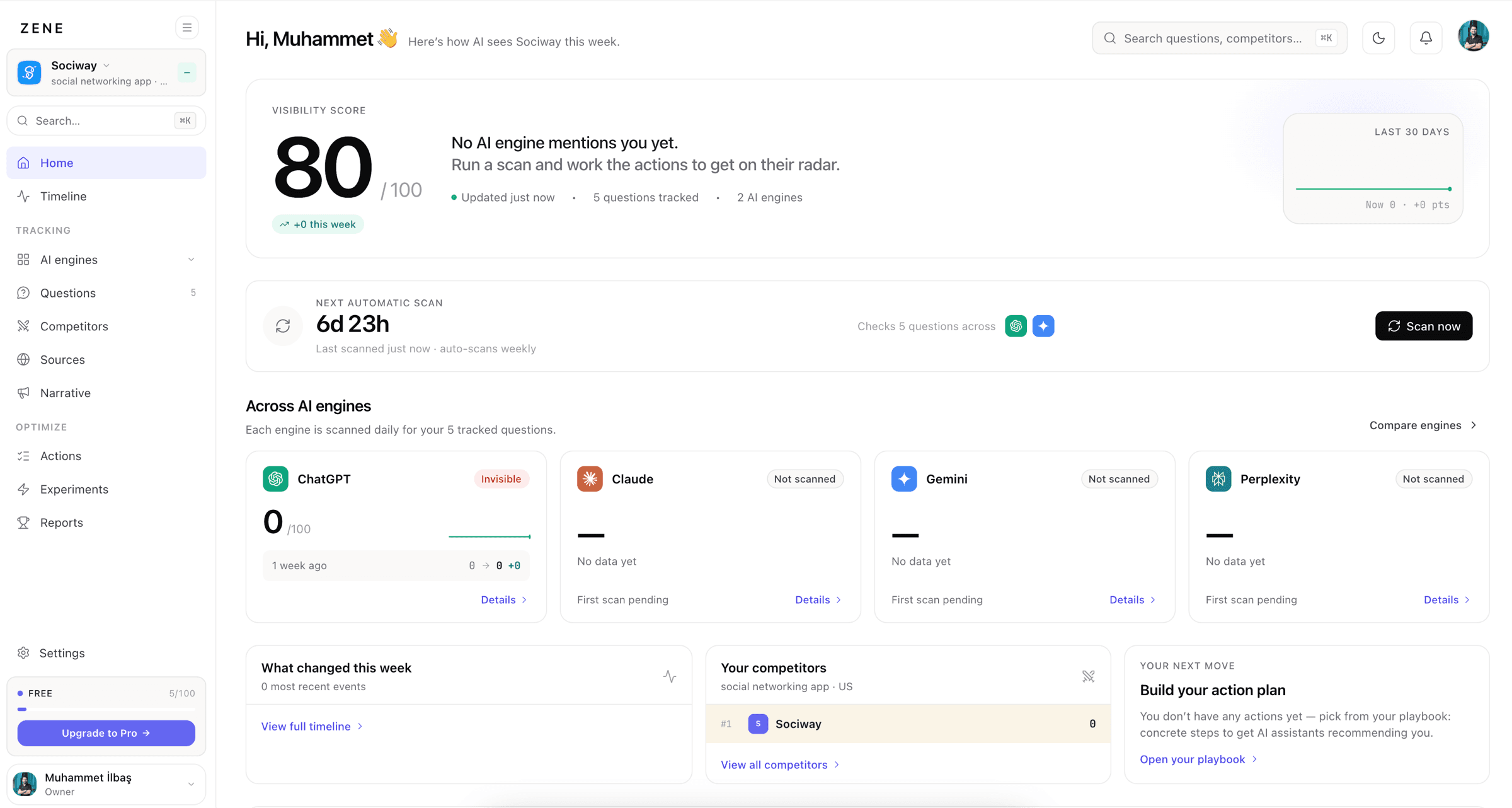
ChatGPT visibility tracker
ChatGPT is the assistant most of your buyers actually open. See whether it knows you, recommends you, or quietly sends them to a competitor - and watch it change over time.
Free first scan on your own brand - see exactly where ChatGPT places you.
ChatGPT answers in two minds
ChatGPT answers in two minds - from memory for familiar topics, and from a live web search when a question is fresh. So winning it is two jobs at once: being remembered in training, and being findable and quotable the moment it searches. Zene measures both on your real questions.
Run a free ChatGPT scanEverything you need to win ChatGPT.
Rankings, share of voice, the sources ChatGPT cites and the next action to take - in one place.
Brand rankings on ChatGPT
How often ChatGPT names you versus the competitors in your category.
Share of voice
Your slice of the answers ChatGPT gives for your buyers' questions.
Cited sources
Which domains ChatGPT pulls from - your map of where to get listed.
Action center
Every gap becomes a ranked, ChatGPT-specific action.
Visibility by prompt
Where you stand on each buyer question, trended over time.
How ChatGPT decides which brands to name
There's no ranking to climb and no form to submit. ChatGPT assembles a recommendation from two sources - what it learned and what it can find right now - and weighs them in a fairly consistent way.
It reaches for memory first
Before searching anything, ChatGPT leans on training data. Brands that were widely written about - documentation, comparison posts, Reddit threads, news, a clean encyclopedic footprint - are the ones it recalls unprompted. If you weren't part of that corpus, you start the answer invisible.
It searches when the question is fresh
Ask about current pricing, a new feature, or the 'best tool in 2026' and ChatGPT triggers a live search, reads a handful of pages and quotes them. Here, being crawlable by OAI-SearchBot and having a page that answers the question in plain sentences is what gets you through the door.
It trusts consensus over claims
The model weighs what many independent sources agree on far above what your own site asserts. A confident line on your homepage counts for little next to the same fact echoed across third-party pages it considers credible.
It composes, then maybe attributes
The final answer is a synthesis. When it browsed, it cites; when it answered from memory, it usually won't - which is how a brand gets recommended with no link attached. Tracking the words, not just the citations, is the only way to see that happen.
What actually moves your ChatGPT visibility
Two clocks, two playbooks. The memory game compounds slowly and lasts; the search game pays off in days.
Get into the training picture
Earn mentions where model builders scrape - established review sites, comparison articles, active communities, an accurate encyclopedic presence. It's slow to land and hard to fake, which is exactly why it holds for years once it does.
Be quotable on a live search
Ship server-rendered pages that answer buying questions directly, and let OAI-SearchBot in. The browsing path can pick you up within days, long before the next model refresh ever would.
Correct what it remembers wrong
Stale training data is the classic ChatGPT failure - an old price, a former name, a feature you retired. You fix it by changing the sources it will re-learn from, then watching the answer catch up.
No. There's no ad slot or submission form that places your brand inside an organic ChatGPT recommendation. It assembles answers from training data and live retrieval, so the only way in is to be genuinely easy to find, read and quote.
On two clocks. Its trained memory only moves when OpenAI ships a new model, which can be months. Its live-search view of you updates whenever it browses - effectively in real time. A change you make can show up in the search path within days while the memory path lags well behind.
Only when it browsed the web for that answer. Replies drawn from memory usually carry no links, which is why a brand can be recommended with nothing to click. That's also why tracking the mention itself - not just citations - matters.
Usually one of three reasons: it never learned you (thin training-data footprint), it couldn't read or reach your site when it searched, or it found nothing quotable to pull. A scan tells you which one is yours, on the specific questions where you're losing.
No. You can rank first on Google and still be absent from ChatGPT, because it builds recommendations from training and retrieval rather than your search position. It has to be measured on its own.
It's the closest honest equivalent. ChatGPT has no ranked results page - it writes an answer that names a few brands and omits the rest - so there is no literal 'rank' to report. What Zene tracks is the AI-era counterpart: whether you're named at all, how prominently, in what tone, and against which competitors, trended over time like the rank reports you're used to.
Your buyers don't ask just one.
See where you stand in ChatGPT.
Run a free Zene audit and get your ChatGPT visibility score - plus the competitors winning the answers you're missing - in minutes.