Search for "best AI SEO tools" and you'll get lists that put a writing assistant, an enterprise SEO suite and a ChatGPT-tracking dashboard in the same top ten - as if they did the same job. They don't. "AI SEO tools" is one label hiding three different jobs, and buying from the wrong category is the most common way teams waste this budget. Full disclosure before the map: we make Zene, a tool in the third category - treat our entry with the same skepticism you'd apply to any vendor writing a listicle.
The three jobs hiding under one label
- Job 1 - use AI to make content that ranks. Research, draft, optimize: tools that read the SERP for your target query and help you produce something competitive, faster.
- Job 2 - use AI to run classic SEO faster. The established suites folding AI into what they already do: research, audits, briefs, reporting.
- Job 3 - measure AI itself as a search surface. Your buyers are asking ChatGPT and Perplexity directly; these tools track whether the answers name you. Different scoreboard entirely.
| Job | Representative tools | Scoreboard |
|---|
| AI content optimization | Surfer, Clearscope, Frase | Google rankings for target pages |
| AI inside SEO suites | Semrush, Ahrefs, SE Ranking | Rankings, traffic, share of SERP |
| AI visibility / GEO tracking | Profound, Peec, Otterly, Zene | Mentions inside AI answers, vs competitors |
Job 1: AI content tools - where AI SEO started
Surfer, Clearscope and Frase are the recognizable names here: they analyze what currently ranks for your target query and guide your draft toward competitive coverage - topics to include, questions to answer, structure that matches intent. Used well, they compress the research-and-brief stage dramatically. Used lazily, they produce the same optimized-but-generic page as everyone else using the same tool - which is exactly the content answer engines have the least reason to cite. And the elephant in this category is free: a large share of teams now do first drafts and briefs in ChatGPT or Claude directly, and the paid tools justify themselves on workflow and SERP data, not on the writing itself.
Job 2: the suites - AI folded into classic SEO
Semrush, Ahrefs and SE Ranking have all been layering AI through their platforms - automating keyword research, surfacing audit findings, drafting briefs and summarizing reports. If your team already lives in one of these, its AI features are usually the cheapest real upgrade in this whole article: no new tool, no new data source, just less manual work on the SEO you were doing anyway. Notably, the suites are also reaching toward job 3 - several now offer AI-answer tracking modules of varying depth - a useful signal that the category boundary itself is where the market is heading.
Job 3: AI visibility - measuring the answers themselves
This is the category that didn't exist three years ago. When buyers ask ChatGPT what to buy, no rank tracker sees it - these tools do: they ask the engines your buyers' questions on a schedule and track whether you're named, in what tone, against whom, citing which sources. Profound leads the enterprise end with response-level depth for data teams (custom enterprise pricing after a trial). Peec AI is the mid-market challenger, strongest on competitive positioning ($95/mo (50 prompts, 1 project, 3 of 6 models)). Otterly covers budget monitoring (Lite $29/mo ($25 yearly): 15 prompts, 1 workspace). Prices as checked on October 4, 2026; they move constantly, so confirm on each vendor's page. The full comparison - engines covered, prices, pros and cons, gaps - is in the best AI visibility tools and trackers.
Where Zene fits (our bias, stated plainly)
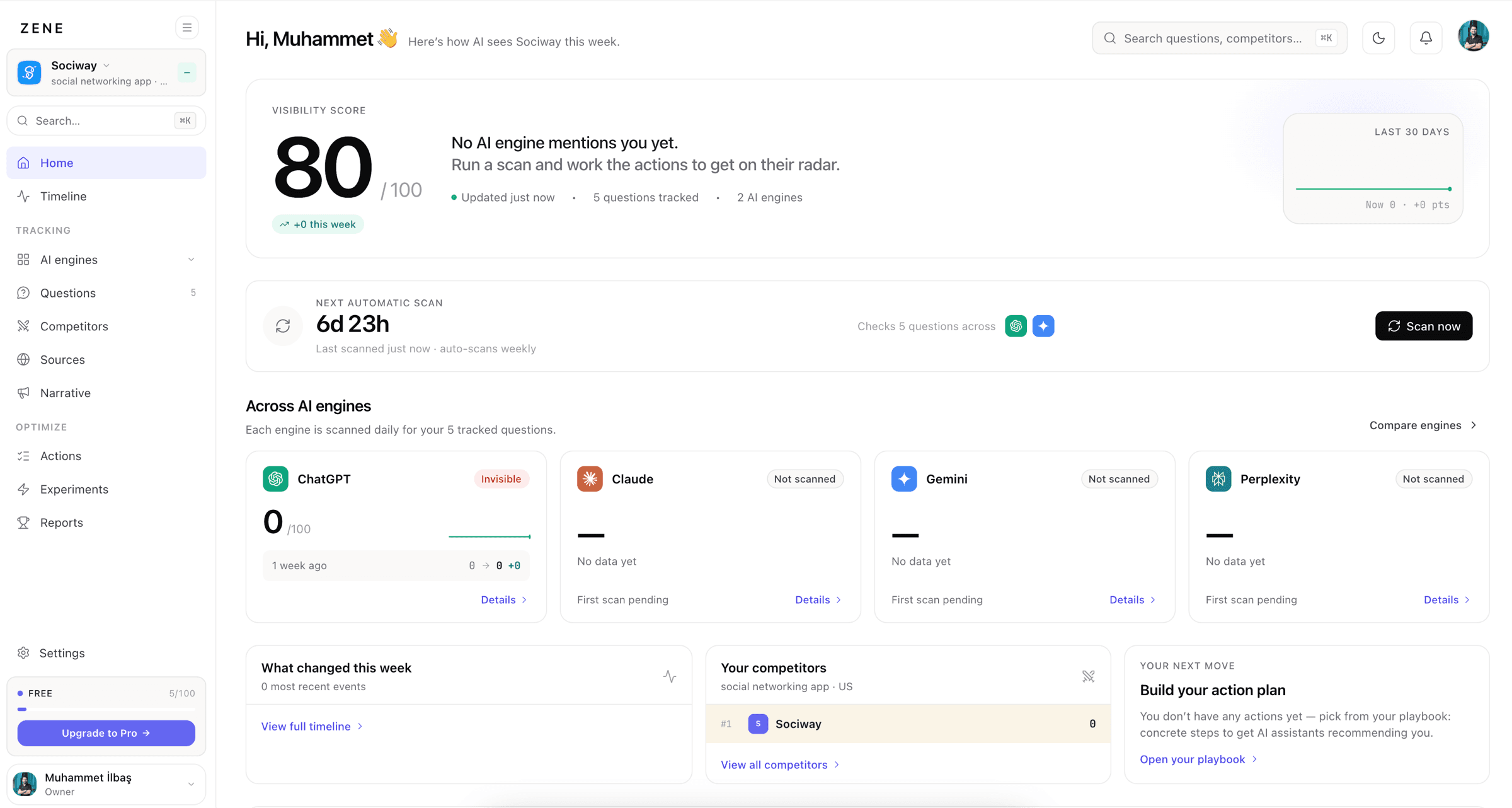
Zene is our entry in job 3, built around the gap we kept seeing: most visibility tools stop at measurement. Zene tracks all five major engines (ChatGPT, Gemini, Perplexity, Claude, Grok) with competitors and cited sources in the same frame - then turns the findings into a prioritized action plan rather than another dashboard. It's aimed at founders and lean teams; the free tier exists so you can baseline before spending anything. That's the pitch - judge it against the criteria below like every other vendor here.
How to choose without regretting it
- Name the job first. "We need AI for SEO" is three different purchases. Which scoreboard is actually broken - content production, SEO throughput, or AI-answer presence?
- Don't double-buy job 1. If your team is fluent with ChatGPT or Claude, trial whether a paid content tool beats your current drafts before paying for the workflow.
- Check your suite before adding a tracker - but check the depth: engine coverage, competitor share of voice, and whether cited sources are exposed vary enormously between a bolt-on module and a dedicated tool.
- Data or direction? The question that splits every category: does the tool hand you findings, or tell you what to do about them? Price the hours between those two.
One test that works across all three categories: ask what you'd do differently next Monday based on the tool's output. If the answer is "read more dashboards," keep shopping.
The honest bottom line
If content production is the bottleneck, start with job 1 - or prove ChatGPT can't do it for you first. If you live in Semrush or Ahrefs, turn on the AI features you're already paying for. And if your real worry is "buyers ask AI and I have no idea what it says about us" - that's job 3, no classic tool measures it, and it's the one place we'd obviously tell you to try ours. Weight all of us by the quality of the direction, not the volume of the data.
The cheapest way to find out whether job 3 is your problem: a free Zene baseline - your buyer questions on ChatGPT and Gemini (all five engines on Pro), about 90 seconds. If the answers already name you generously, spend the budget on jobs 1 and 2.
Frequently asked questions
What are AI SEO tools?
The label covers three genuinely different product categories. First, AI-assisted content tools that help you research, draft and optimize pages (Surfer, Clearscope, Frase and peers). Second, AI features inside classic SEO suites - Semrush, Ahrefs, SE Ranking - that automate research, audits and reporting. Third, AI visibility tools that measure the new surface itself: whether ChatGPT, Gemini, Perplexity and other assistants mention your brand when buyers ask. Before comparing tools, decide which of the three jobs you're actually hiring for.
Which AI SEO tool is best?
There's no single best - the categories solve different problems. If your bottleneck is producing competitive content, an AI content-optimization tool pays off fastest. If you already live in an SEO suite, its built-in AI features are usually the cheapest upgrade. If your buyers are asking ChatGPT and Perplexity instead of Google, none of the above measures that - you need an AI visibility tracker. The expensive mistake is buying a tool from one category to solve a problem that belongs to another.
Do AI SEO tools replace human SEOs?
No. The tools compress execution - drafts, audits, briefs and reports that took days now take hours - but they don't supply judgment: which questions are worth winning, whether a page should exist at all, what your positioning against competitors ought to be, and whether the AI's confident output is actually correct. Teams that treat AI SEO tools as leverage for a strategy outperform teams that treat them as the strategy.
What's the difference between AI SEO tools and AI visibility tools?
Direction of optimization. Most AI SEO tools use AI to help you win classic search - better content, faster audits, automated research, with Google rankings still the scoreboard. AI visibility tools point the other way: they measure whether AI engines themselves name and recommend your brand when buyers ask, engine by engine, against competitors. The first uses AI as a means; the second treats AI answers as the end. Mature stacks increasingly need one of each.
What are the best free AI SEO tools?
More of this stack is free than the listicles admit. For content work, ChatGPT and Claude handle research, outlines and first drafts well enough that paid content tools have to beat them to earn their fee. The established suites offer free tiers or trials generous enough to test their AI features on a real project. And for AI visibility, free baselines exist - HubSpot's AI Search Grader for a one-off look, and Zene's free tier for a scan of how five engines answer your buyer questions. Start free, identify which job actually hurts, and pay only for that.
 Muhammet İLBAŞ 11 min