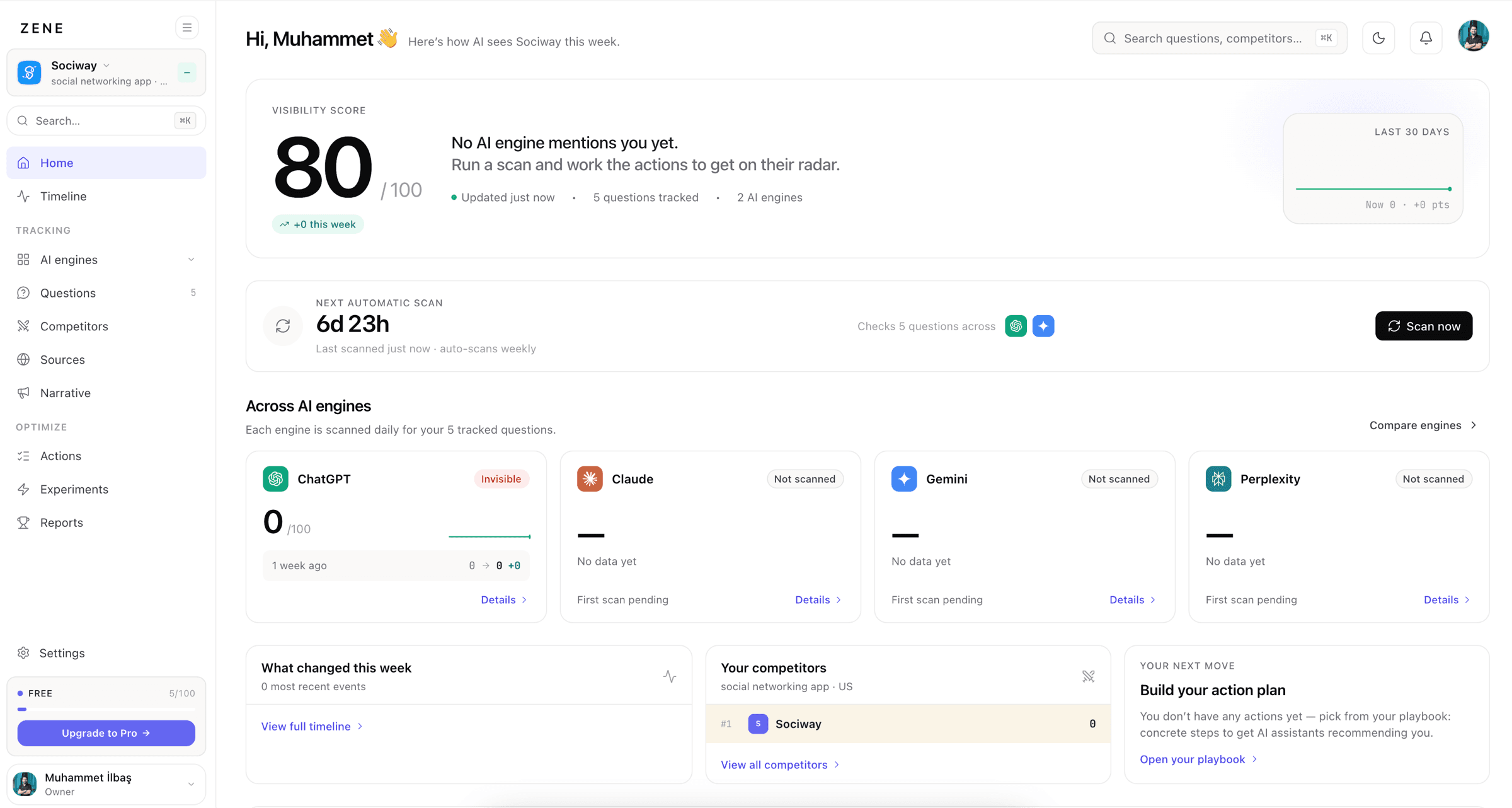
For years this channel had no scoreboard. You'd hear "ChatGPT recommended a competitor" from a customer and have no idea whether that was one unlucky answer or a pattern. Now it's measurable - but most people reach for the wrong number first, so here's the hierarchy of metrics that actually tells you whether AI engines are on your side.
One principle up front: a metric is only useful if a bad reading changes what you do next. "We got 200 mentions this month" fails that test - 200 out of what? Versus whom? Trending which way? The metrics below are built to answer those questions instead.
The base metric: visibility rate
Take the set of buyer questions you care about - "best X for small teams," "alternatives to Y" - and measure the share where the engine names you at all. That's your visibility rate, and it's the foundation everything else refines. The denominator is what makes it honest: it counts the answers you could have appeared in and didn't, which a raw mention tally quietly hides.
Why not just count mentions? Because the count goes up when you add questions, when a category gets more popular, when you simply look more often. A rate controls for all of that - it can fall even as your raw mentions rise, and that fall is exactly the signal you want to catch early.
Share of voice: you versus the field
Visibility rate tells you if you show up; share of voice tells you whether you're winning the answer. If an engine names three brands and one is you, your share on that question is a third. Averaged across your tracked questions and compared to competitors, it's the closest thing to "category market share inside the AI" - and because a recommendation often decides the purchase, it maps to pipeline more directly than any traffic number. Traffic still belongs on the scorecard as the downstream check - here's how to track ChatGPT and AI referrals in GA4, and what GA4 misses.
Position: named first, or buried in the list
Not all mentions are equal. Being the first brand an engine names carries far more weight than being the fourth in a hedge-everything list, the same way a top organic result outperforms one at the bottom. Track where in the answer you land, not just whether you're in it - movement from "also consider" to "the best option for" is real progress that a binary mentioned/not-mentioned metric misses entirely.
Citation share: are your sources doing the work
When an engine searches the web, it cites sources - and those citations are a leading indicator. If your own pages and the third-party pages about you are getting cited as sources, mentions tend to follow; if rivals own the citations, you're reading from their script. Tracking which domains get cited for your category (yours, competitors', neutral third parties) shows you the supply chain behind the answer, not just the answer. Keep it separate from share of voice: a mention and a citation are different signals, and they move for different reasons.
Sentiment and accuracy: named, but how
A mention can hurt. An engine can name you with a stale price, the wrong category, or a lukewarm "some users find it complex." So pair presence with two quality reads: is the description accurate, and is the framing positive? A confidently wrong answer is its own problem with its own fix, and it won't show up in any count of mentions.
Engine coverage: the average lies
Because the engines disagree on sources and answers, a single blended number hides the thing you most need to act on. You can sit at a healthy 70% visibility on average while being the default in Perplexity and nearly absent in ChatGPT. Always read these metrics per engine first; the gap between your best and worst engine is usually where the next month of work lives.
Trend and volatility, not snapshots
The single most misused view is the snapshot. AI answers drift week to week, so today's reading carries sampling noise. Two things fix it: a smoothed trend line (so you see direction, not jitter), and a volatility read (how much your answers swing) - a brand that flickers in and out is in a more fragile position than the number alone suggests, even at the same average.
Rolling it into one score
Most teams want a single headline number, and that's fine - as long as it's built from the parts above (weighted visibility, share of voice, position, with sentiment and coverage as modifiers) rather than a raw count dressed up. We went deep on the trade-offs of doing that honestly in what an AI visibility score is and how to calculate one. The headline is for the dashboard; the components are what you actually steer by.
The trap to avoid: optimising the vanity metric. Chase raw mention count and you'll celebrate adding questions and a busy category. Chase visibility rate and share of voice per engine, trended over time, and you're measuring the thing that converts.
You can't improve what you only sample once. A free Zene audit establishes these metrics on ChatGPT and Gemini (all five engines on Pro) - so the next time a customer says "the AI recommended someone else," you'll already know whether it's noise or a trend.
Frequently asked questions
What is the most important AI visibility metric?
Visibility rate - the share of the buyer questions you track where an engine names your brand at all. Everything else (share of voice, position, sentiment) refines that base signal. A single raw mention count is a vanity metric because it ignores how many questions you could have appeared in and lost.
What is share of voice in AI answers?
The proportion of relevant answers that name you versus your competitors. If ChatGPT names three brands for a question and you're one of them, your share of voice on that question is one-in-three. Tracked across many questions, it tells you whether you're winning or losing the category inside the answer - which is what actually moves pipeline.
How often should AI visibility metrics be measured?
Often enough to separate signal from noise. AI answers drift week to week, so a quarterly snapshot can't tell a real change from sampling variance. Daily or weekly tracking with a smoothed trend line is the sane cadence - frequent enough to catch a regression, smoothed enough not to react to every flip.
 Muhammet İLBAŞ 9 min