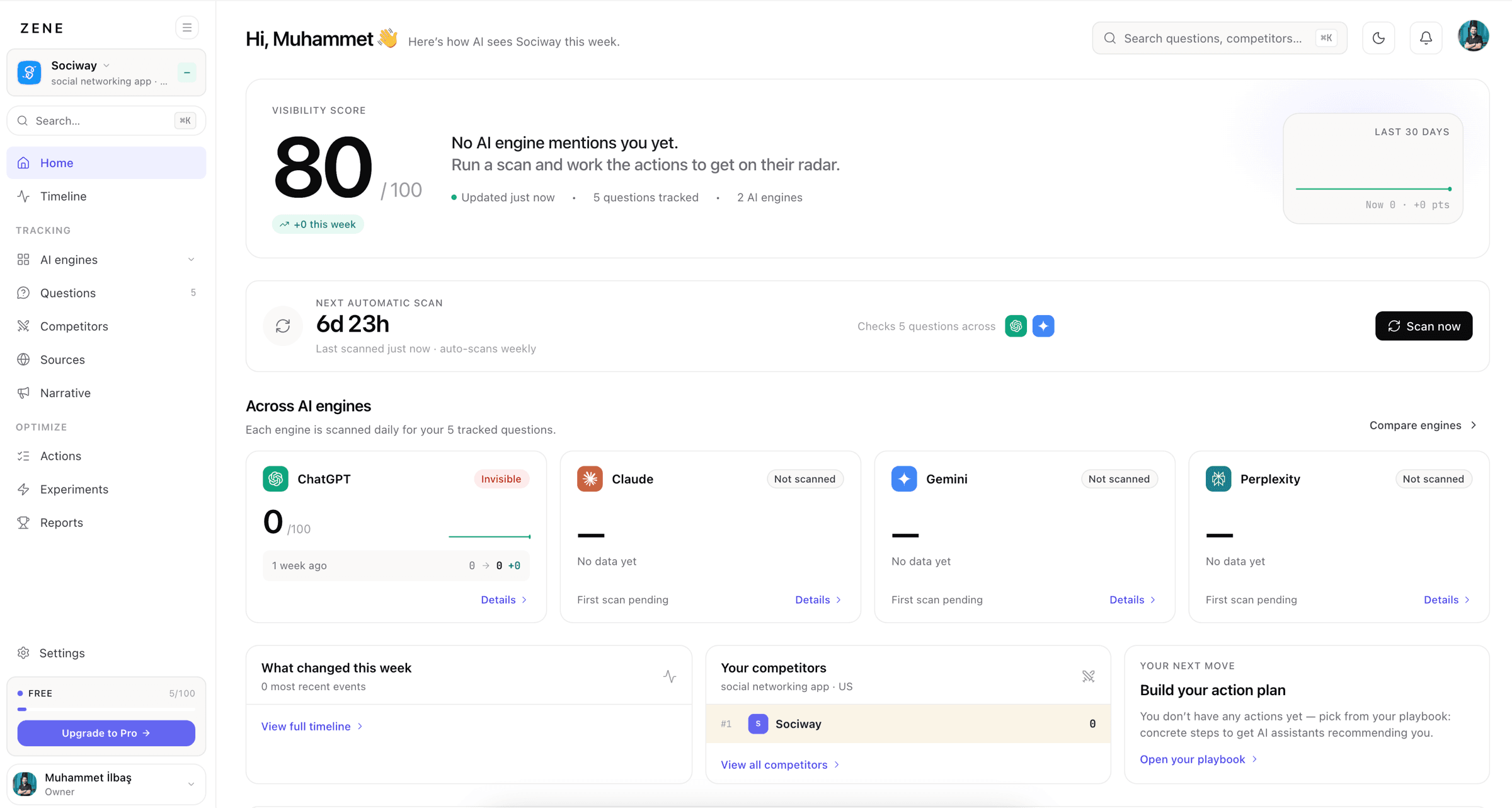
Every GEO tool - Zene included - sells some version of a number: your AI visibility score. Numbers create trust they haven't always earned, so here's what one should actually contain, how ours is built, and the shortcuts that make some scores meaningless. Buy ours or build your own spreadsheet - either way, know what's under the number.
Mention rate, on real questions
The base signal: across a fixed set of buyer questions, in what share of answers do you appear? The phrase "fixed set" is load-bearing - if the question set drifts week to week, the trend line is noise. And the questions must be buyer-shaped ("best X for Y"), not brand-shaped ("what is Zene?"), or the score flatters you.
Position
Being the first recommendation and being sixth in an "other options include…" list are different outcomes. A score that counts them equally overstates weak presence. Weight by position.
Accuracy and framing
A mention that gets your pricing wrong or recommends you for the wrong use case can be worse than absence. The score should distinguish a clean, correct recommendation from a garbled one - and surface the garbled ones for correction.
Per-engine separation
One blended number across ChatGPT, Claude, Gemini and Perplexity hides the most actionable information, because the engines disagree. You need the per-engine breakdown to know where to work.
Why scores move when you did nothing
Models are stochastic: the same question can produce different shortlists run to run. A single daily sample per question will jitter, and an honest tool damps that - multiple samples, smoothing, and change-detection thresholds before alerting you. If a tool's score swings ten points day to day, that's sampling noise dressed as drama.
Questions to ask any vendor (including us): How many prompts? Who writes them? How many runs per data point? Is position weighted? Can I see the raw answers? If the raw answers aren't inspectable, the score isn't auditable.
The score is the start, not the product
A number tells you that you're behind, not why. The useful layer underneath is diagnostic: which questions you lose, who wins them, which sources the engines cited when they answered. That's what turns a score into a to-do list - and it's why we treat the cited-source report as the real product, with the score as its headline.
Your number is the easy part to produce; the answers behind it are the point. See both - free, in minutes.
Frequently asked questions
What is AI visibility?
AI visibility is how often, how accurately and how prominently an AI assistant names your brand when someone asks it a question you'd want to win. Four things decide it: how frequently you come up, whether the engine describes you correctly, where you land in the list, and whether it cites your own site as the source. Strong on all four and you're the answer; weak on any one and a competitor takes the recommendation.
How is an AI visibility score calculated?
Done honestly, it starts with your mention rate across a fixed set of real buyer questions, weights that by position - being the first recommendation beats being sixth - adjusts for whether the mention is actually accurate, and reports each engine separately instead of blending ChatGPT, Claude, Gemini and Perplexity into one flattering average. A score built any other way mostly measures luck.
What counts as a good AI visibility score?
There's no universal pass mark - a 40 in a crowded category can be worth more than an 80 in a niche nobody else contests. What matters is the trend on a fixed question set and the per-engine split, because that's what tells you whether you're gaining ground and where. Treat any vendor's single headline number as a starting point, not a grade.
Is AI visibility the same as my Google ranking?
No, and that's the trap. You can sit at the top of Google and still be absent from ChatGPT's answer, because the engines build their recommendations from training data and live retrieval, not from your search rank. AI visibility has to be measured on its own - your Google position predicts almost nothing about it.
 Muhammet İLBAŞ 9 min