AI visibility tracker
Track whether ChatGPT, Gemini, Claude, Perplexity and Grok mention and recommend your brand on the questions your buyers actually ask - scored, trended, and watched for the day an answer changes.
Free on ChatGPT & Gemini for your own brand - all five engines on Pro.
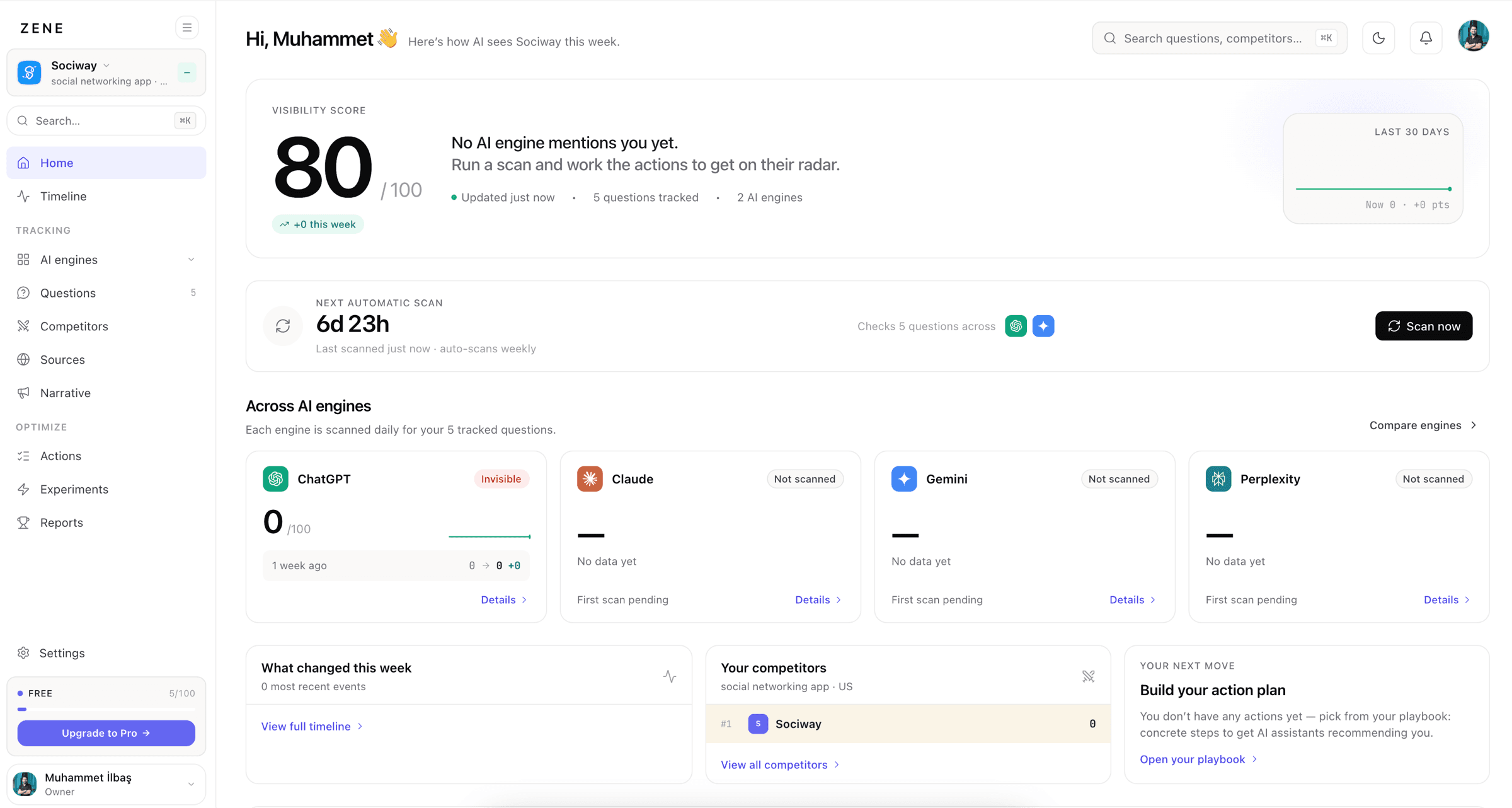
One score across every engine
Your buyers don't ask one assistant - they ask whichever one is open. Checking each by hand is slow, inconsistent and forgotten by next week. An AI visibility tracker runs the same buyer questions through all five engines on a schedule and turns the answers into one number you can actually act on.
See which engine recommends you, which sends buyers to a competitor, and the exact moment any of them changes its mind - with the before and after saved side by side.
Run a free scanEverything an AI visibility tracker should show you.
Rankings, share of voice, the sources each engine cites and the next action to take - across all five assistants, in one place.
Brand rankings
How often the engines name you versus the competitors in your category.
Share of voice
Your slice of the answers the engines give for your buyers' questions.
Cited sources
Which domains the engines pull from - your map of where to get listed.
Action center
Every gap becomes a ranked, engine-specific action.
Visibility by engine
Where you stand on each assistant, trended over time.
How AI engines decide which brands to recommend
There's no ranking to climb and no form to submit. Every assistant assembles a recommendation from two sources - what it learned and what it can find right now - and the mechanics rhyme across all of them.
They answer from memory first
Before searching anything, an assistant leans on what it learned in training. Brands written about widely - documentation, comparison posts, community threads, a clean encyclopedic footprint - are the ones it recalls unprompted. Miss that corpus and you start every answer invisible.
They search when the question is fresh
Ask about current pricing, a new feature, or the 'best tool in 2026' and most engines trigger a live search, read a handful of pages and quote them. Here, being crawlable to their bots and answering the question in plain sentences is what gets you through the door.
They trust consensus over your own claims
What many independent sources agree on counts far more than what your homepage asserts. A confident line about yourself is worth little next to the same fact echoed across third-party pages the model considers credible.
They compose an answer, then maybe cite
The reply is a synthesis. When an engine browsed, it cites; when it answered from memory, it usually won't - which is how a brand gets recommended with no link attached. The only way to see that is to track the words, not just the citations.
What actually moves your AI visibility
Two clocks, four playbooks. The memory game compounds slowly and lasts; the search game pays off in days - and you want coverage on every engine while you work both.
Get into the training picture
Earn mentions where model builders scrape - established review sites, comparison articles, active communities, an accurate encyclopedic presence. Slow to land and hard to fake, which is exactly why it holds for years once it does.
Be quotable on a live search
Ship server-rendered pages that answer buying questions head-on, and let the AI crawlers in. The retrieval path can pick you up within days - long before the next model refresh ever would.
Fix what they get wrong
Stale training data is the classic failure: an old price, a former name, a feature you retired. You fix it by changing the sources the models re-learn from, then watching the answers catch up.
Cover every engine, not just one
Each assistant weighs sources differently, so the brand ChatGPT names isn't always the one Gemini or Claude picks. Tracking all of them is the only way to find the engine where you're quietly losing.
A dedicated tracker for each engine
The mechanics differ enough per model that each one is worth understanding on its own. Start with the engine your buyers use most.
AI visibility, answered.
The things teams ask before they start tracking their brand across the engines.
Run a free scanIt's a tool that runs the questions your buyers actually ask through the AI assistants - ChatGPT, Gemini, Claude, Perplexity and Grok - and records whether each one mentions and recommends your brand. Instead of guessing what AI says about you, you get a measured, repeatable score, the competitors winning your answers, and the sources each engine cites.
Zene scans every engine on the same set of buyer questions on a schedule, then trends each one's visibility over time so you can see exactly where you stand and what changed. You don't ask the assistants by hand - the tracker does it for you, scan after scan, and saves the before-and-after when an answer shifts.
Yes - Zene's free plan scans your own brand on ChatGPT and Gemini, on demand, so you see where they place you before you decide on anything. Continuous, scheduled tracking across all five engines is what the paid plans add: daily on ChatGPT, Gemini and Grok, with Claude and Perplexity refreshing on a rolling weekly window on Pro (every five days on Agency).
Because each model is grounded differently. ChatGPT and Claude lean on training memory, Perplexity searches the live web for almost everything, Gemini rides Google's index, and Grok weights the real-time conversation on X. A brand strong in one of those signals can be absent from the others - which is the whole reason to track all of them, not just the one you happen to check.
No. You can rank first on Google and still be missing from ChatGPT, because assistants build recommendations from training and retrieval rather than your search position. AI visibility has to be measured on its own - that's what this tracker is for.
Constantly, and on different clocks per engine. A retrieval-first engine like Perplexity can reflect a content fix within days; a memory-led one like ChatGPT may not move until the next model refresh. Scheduled scans catch each shift soon after it lands instead of you finding out months later.
Same instinct, new surface. A rank tracker watches your position in a list of results; an AI visibility tracker watches a surface that has no positions - a written answer that names two or three brands and omits the rest. So instead of a rank, it records whether each engine names you, how prominently, in what tone, against which competitors and citing which sources. If you're searching for a 'ChatGPT rank tracker' or 'Gemini rank tracker,' this is the measurable version of that idea.
See where you stand across every AI engine.
Run a free Zene audit and get your AI visibility score - plus the competitors winning the answers you're missing - in minutes.