For a year the AI answer in Google Search was a paragraph you could scroll past. AI Mode is the version you can't: a dedicated tab where the AI answer is the search result - a full, conversational response you can keep questioning, with the classic links demoted to supporting cast. Google has been rolling it out steadily since 2025, and it sits one tap away from every search box its users already live in.
For a brand, that raises the same question AI Overviews did, with higher stakes: when a buyer asks AI Mode about your category, are you one of the names in the answer? This is how AI Mode actually builds that answer, why it's a different placement from an AI Overview even though the two rhyme, what that means for getting named - and an honest look at what "tools for AI Mode" can and can't measure today.
What AI Mode actually is
AI Mode is Google's conversational search surface: ask a question, get a synthesized answer written by a Gemini model, grounded in Google's index, with links to a subset of the pages it drew on - and a conversation thread instead of a results page, so the follow-up question is part of the same session. It's the fuller commitment to the pattern AI Overviews introduced. An Overview summarizes above the links; AI Mode largely replaces them.
The three Google surfaces, untangled: AI Overviews are summaries stapled to the top of classic results - we covered them in the AI Overviews guide. AI Mode is the separate conversational search tab. The Gemini app is a standalone assistant. All three run on the same model family and Google's index, but they are three different placements - a brand can be present in one and missing from the others.
How it assembles an answer: query fan-out
The mechanic that makes AI Mode different - and that Google has described publicly - is query fan-out. AI Mode doesn't run your question as one search. It breaks it into several related sub-queries, searches each, and synthesizes one answer from everything it retrieved. Ask "best project tool for a small agency that bills hourly" and it may separately search the category round-ups, the billing-feature comparisons, the agency-specific threads - then write a single response stitched from all of them.
Three consequences follow for anyone trying to be in the answer:
- The long tail got promoted. You're no longer competing only on the head query; you're competing on every sub-question it fans out into. A page that thoroughly answers one narrow sub-question can earn you a citation in an answer to a much broader question.
- Passages beat pages, even more than in Overviews. The synthesis wants the clearest, safest statement of each sub-claim. Direct, self-contained answers near the top of a section are what get lifted; buried answers get skipped for a competitor's cleaner one.
- Classic SEO is still the entry ticket. Fan-out searches run on Google's index. If you don't rank anywhere real for the sub-questions of your category, you're not in the candidate pool the model reads from. Everything we wrote about SEO still mattering applies here with interest.
Why this placement is worth taking seriously
Two honest observations, no invented numbers. First, AI Mode inherits Google's distribution: it doesn't need to win users from Google because it lives inside Google - the adoption question is only how many searchers switch tabs, and Google keeps making that switch more prominent. Second, the click economics are harsher than Overviews: the answer is the whole experience, so if it resolves the buyer's question and names two competitors, there is no list of blue links below where your #1 ranking saves you. The answer is the shelf; you're on it or you're not. That's the same "ranked is not recommended" shift the assistants forced - arriving inside the biggest search box in the world.
"Tools for AI Mode" is a young category, and the honest map has three bands rather than one winner. (We've since broken the full tool landscape - including the free stack - into its own guide: tools for Google AI Mode.)
1. Google Search Console - free, official, and blended
Google includes AI Mode impressions, clicks and positions in Search Console's performance data - but folded into the overall Web search totals, with no separate AI Mode filter to isolate them. So your GSC numbers already contain your AI Mode performance; you just can't see which part is which. It's worth watching all the same: it's the only first-party signal there is, and a rising-impressions, falling-clicks pattern on informational queries is often the AI layer absorbing reads that used to be visits.
2. SEO suites adding AI-answer tracking
The established rank-tracking vendors - Semrush, Ahrefs, SE Ranking and their peers - have been extending toward Google's AI surfaces, typically starting with AI Overview presence on tracked keywords. Depth varies by vendor and moves quarter to quarter, so the question to ask any of them is specific: which Google AI surfaces do you capture, and how is that sampled? We keep a broader comparison of the category in our AI visibility tracker field guide.
3. AI visibility trackers - measuring the engine underneath
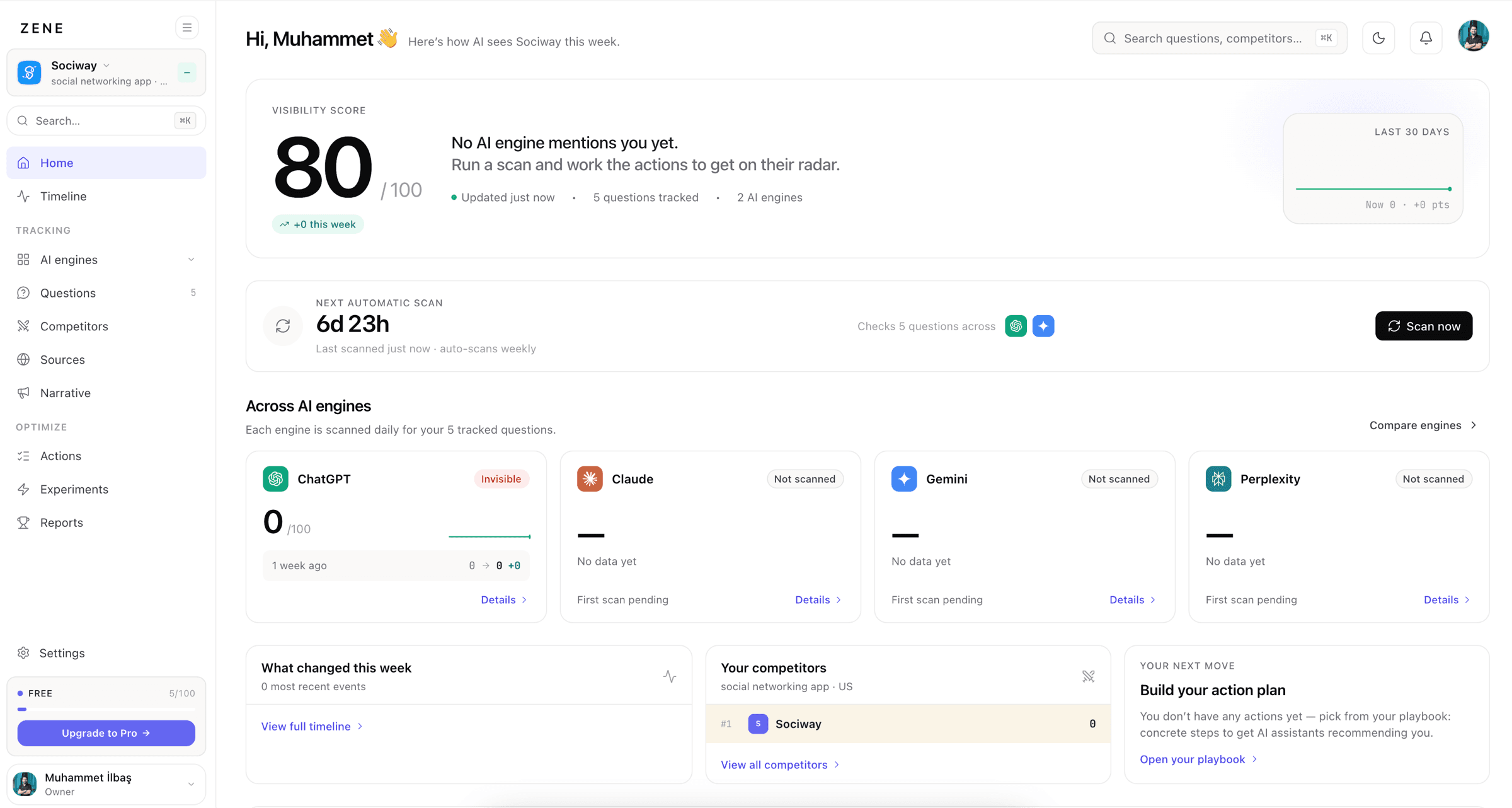
The third band tracks the thing AI Mode is made of: whether the AI engines themselves name and recommend your brand. That's the layer Zene works at - an AI visibility tracker that runs your real buyer questions through the engines on a schedule, including Gemini, the model family powering AI Mode and AI Overviews. Honest scope, stated plainly: that measures what Google's AI layer knows and says about you - the substance AI Mode's answers draw on - not a screenshot of the AI Mode tab itself. The two move together for the same reason AI Overviews and Gemini answers move together: same models, same index, same retrieval instincts.
Whichever band you buy from, the test is the same one we apply to every tool in this category: does it show you the answer substance (who got named, citing which sources), or just a presence checkbox? The substance is what you can act on.
How to get your brand into AI Mode answers
There's no AI Mode submission form, no schema type that forces inclusion, and nobody can guarantee you a mention - the same honesty that applies to every engine. What the mechanics reward:
- Cover the sub-questions, not just the head term. Fan-out means the answer is assembled from many narrow searches. Map the questions around your category - pricing, comparisons, use-case fits - and make sure each has a page (yours or a third party's) where you're the clear answer.
- Write for extraction. One claim per section, stated plainly in the first sentence or two, specific enough to be safe to quote. The citable-pages playbook applies verbatim.
- Earn corroboration off your domain. AI Mode reads the round-ups, review sites and communities that rank for your category's sub-questions. Being consistently described across them is what makes a model confident enough to name you - the same third-party work in the 90-day GEO plan.
- Keep the crawler doors open and the markup clean. Googlebot reachability and sensible structured data are baseline plumbing here, not differentiators - but missing them disqualifies you before content quality is even judged.
How to measure it without fooling yourself
A workable AI Mode measurement loop, with today's tooling: track whether Google's AI layer names you on your real buyer questions (that's the engine-level scan); watch which sources it cites for your category, because those domains are the shelf your fan-out sub-answers are read from; keep an eye on GSC for the impressions-up-clicks-down signature; and re-check after you ship, on a schedule rather than a vibe. Single spot-checks mislead here for the same reason they mislead everywhere in this discipline - the answers drift - so trend it or don't bother.
Try it on your brandSee whether Google's AI layer - and the other four engines - name your brand when buyers ask.
Type your brand name or domain - we'll line up the questions buyers ask about it.
The takeaway
AI Mode is Google turning the AI answer from a feature into the destination. It picks brands the way its siblings do - retrieve from the index, prefer the clearest corroborated passage per sub-question, synthesize - but the fan-out mechanic raises the value of thorough sub-question coverage, and the all-answer format removes the consolation prize of ranking underneath. The tooling is young: use Search Console for the blended first-party signal, your SEO suite for keyword-level AI presence where it offers it, and an engine-level tracker for the substance. The craft, though, is already settled - be eligible, be quotable, be corroborated. Same work, bigger stage.
Want the baseline? Run a free Zene audit - it shows whether Gemini and ChatGPT name your brand on your real buyer questions (Perplexity, Claude and Grok on Pro), and which competitors they reach for instead.
Frequently asked questions
What is Google AI Mode?
AI Mode is Google's conversational search experience - a dedicated tab in Google Search where, instead of a page of links, you get a full AI-written answer you can keep questioning in follow-ups. Under the hood it runs on Gemini models and Google's index: it breaks your question into multiple sub-searches (Google calls this query fan-out), retrieves pages for each, and synthesizes one answer with links to some of the sources it used. It's a bigger commitment than an AI Overview - the whole result is the AI answer, not a summary above the links.
Are there tools for tracking visibility in Google AI Mode?
The tooling is young but real, in three bands. Google's own Search Console includes AI Mode impressions and clicks in its performance data - but folded into overall Web search totals with no separate AI Mode filter, so you can't isolate it there. SEO suites (Semrush, Ahrefs, SE Ranking and peers) have been adding AI-answer tracking that covers Google's AI surfaces to varying depths. And dedicated AI visibility trackers monitor whether the underlying engines name your brand at all: Zene tracks Gemini - the model family that powers AI Mode - alongside ChatGPT, Perplexity, Claude and Grok, which tells you whether Google's AI layer knows and recommends you, the substance AI Mode draws on.
Is AI Mode the same as AI Overviews?
No - they're sibling surfaces, not the same placement. An AI Overview is a summary stapled above the classic results for some queries; AI Mode is a separate conversational tab where the AI answer is the whole experience. They share machinery (Gemini models grounded in Google's index) and reward the same content qualities, so work that earns you citations in one tends to help in the other - but a brand can be named in one and absent from the other, so they're worth checking separately.
How do I get my brand mentioned in AI Mode answers?
The same craft that wins AI Overviews, applied more thoroughly. Be eligible: indexed, crawlable, and ranking somewhere real for the query and its neighboring sub-questions, because AI Mode fans one question out into many searches. Be quotable: answer each sub-question directly and early, in self-contained language a model can lift. And be corroborated: the same facts about you stated consistently across independent credible sources. There's no meta tag or paid slot that forces you in - the answer is assembled from what Google's index says about your category.
 Muhammet İLBAŞ 9 min