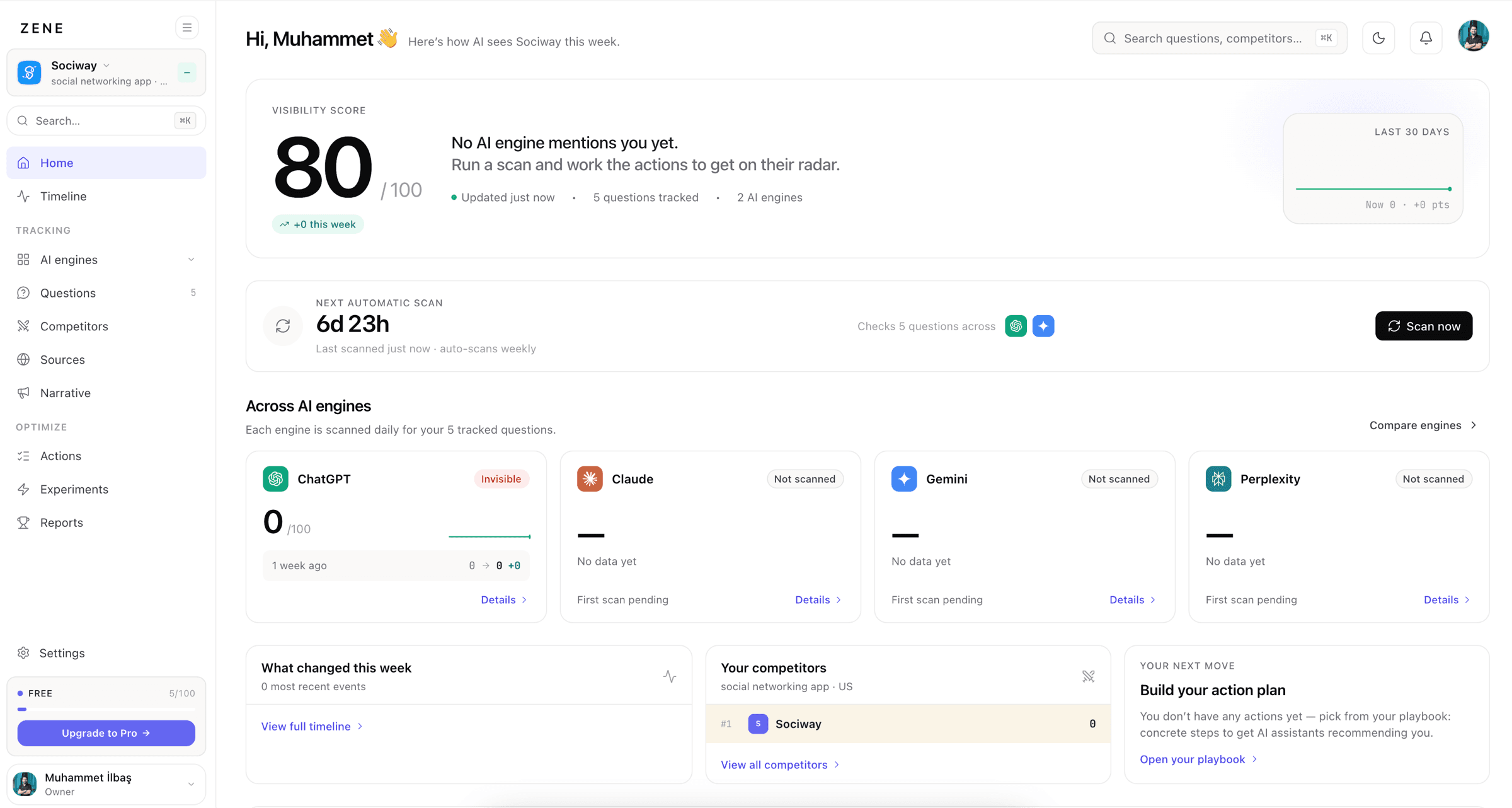
For twenty years the goal was simple: rank. Get your page to the top of the results and the click was yours. That goal still matters, but it's no longer the whole game. When someone opens ChatGPT, Perplexity or Google and types "best [category] for [use case]," they increasingly get a written answer that names two or three options - and either you're one of them or you aren't. There's no page two to scroll to. There's just the answer.
AI search optimization is the work of being in that answer. It overlaps with SEO - the pages engines read are largely the pages that already rank - but the win condition changed. SEO wins a position. AI search optimization wins a mention. This is the practical version: how the answer gets built, the handful of moves that actually shift your odds, the tactics that are a waste of time, and how to know whether any of it is working.
Ranked is not the same as recommended
Here is the reframe the whole discipline hangs on. An AI answer isn't a list - it's a synthesis. The engine reads several pages and writes something new from them, and in doing so it decides which brands to name and which to quietly drop. That means you can rank third for a query, have a genuinely good page, and still be invisible in the answer, because the model summarized the two results above you and never got to your name.
So the unit of work moves. It's no longer "this URL and its position." It's "this claim about my brand, everywhere the engine can see it." The scoreboard moves too: not what position, but were you named, and how were you described. Everything below follows from that shift.
SEO asks: is my page near the top? AI search optimization asks: when the engine writes the answer from pages near the top, does it name me - accurately? You can pass the first test and fail the second.
How an AI answer actually gets assembled
You can't optimize a black box, so start with the mechanics. Every engine builds its answer from two sources, in some mix, and you have to be present in both.
- Memory (training). What the model absorbed from the web when it was trained. If your brand was mentioned widely and consistently across the internet before the cutoff, the model "knows" you and can name you with no search at all. This is slow to earn and slow to change - it only refreshes when the model is retrained.
- Retrieval (live search). For buying-intent and recency-sensitive questions, the engine searches the web mid-answer, reads a few pages, and cites them. This is the fast lane: ship the right pages and get cited on the right third-party sources, and you can appear within weeks - no retraining required.
Different engines lean on these differently, which is why the same question gets different answers on ChatGPT, Gemini and Perplexity. Perplexity is almost pure retrieval; ChatGPT blends memory and search per question. The practical consequence: retrieval is where you can move quickly, so it's where most of the work below aims - but consistency across the web is what eventually earns you the memory too.
The four moves that actually move the needle
Strip away the noise and there are four things worth your time. They're in rough order of leverage.
1. Be on the pages the engine reads - not just your own
When an engine searches your category, it rarely opens your homepage first. It opens the round-ups, comparison articles and review sites that already rank for "best [category]" and "[competitor] alternatives." Those pages are the shelf. If you're not on them, you're not in the shortlist the engine assembles from them - no matter how good your own site is.
So the highest-leverage work is often off your domain: getting listed in the credible comparison pieces, being present and well-reviewed on the sites engines trust, and turning up in the communities they cite. Review platforms like G2 are an AI citation engine almost nobody optimizes deliberately - which is exactly why there's room there.
2. Make your own pages quotable
When the engine does read your page, it's looking for a sentence it can lift. Long, hedged, marketing-fluent paragraphs are hard to quote; a clear claim in a plain sentence is easy. So write for extraction: one question per section, answered completely and self-contained, in the first two sentences, before the caveats.
Concretely - state what you are, who you're for, and what you cost in language a model can repeat verbatim without needing the rest of the page. "Zene is a GEO visibility tracker for brands that want to know if ChatGPT recommends them" is quotable. "Zene empowers forward-thinking teams to unlock next-generation growth" is not - it says nothing a model can attach to a buyer's question.
3. Earn corroboration
One page saying you're the best note-taking app for lawyers is marketing. Five independent pages saying it is a fact the engine will repeat. Models weight consistency: the same claim about you, stated the same way across several sources it trusts, is what turns a hesitant "there's also…" into a confident recommendation.
This is also where accuracy compounds. Keep your category, your audience and your pricing described the same way everywhere - your site, your profiles, the review sites, the comparisons. When the sources agree, retrieval and memory reinforce each other. When they conflict, the engine hedges or picks a competitor whose story is cleaner.
4. Measure per engine, per question
You cannot optimize what you can't see, and "are we visible in AI" is the wrong resolution. Visibility is per engine and per question: you might be named in three of ChatGPT's answers, none of Gemini's, and half of Perplexity's, all in the same afternoon. Average those together and you learn nothing actionable.
So track the real buyer questions - "best [category]," "[competitor] alternatives," "is [brand] worth it" - across each engine separately, and watch two things: whether you're named, and which sources the engine cited when it answered. Doing this by hand across five engines gets unmanageable fast, but the citations are the payoff: they tell you exactly which pages to join or beat.
What to skip. Keyword-stuffing pages "for the model," hidden text, and prompt-injection tricks don't survive contact with how engines actually retrieve - and can get you distrusted. An llms.txt file is a fine 20-minute bet but not a strategy. If a tactic has no plausible mechanism by which an engine would reward it, it's a distraction from the four things above that do.
A worked example
Treat this as an illustration of the mechanic, not a case study. Say you sell a project-management tool and you're invisible when buyers ask AI for recommendations. You check the answers and see the engine keeps citing the same three comparison articles - and you're on none of them. That's not a mystery anymore; it's a task list.
You get accurately listed in those three articles. You rewrite your own "who it's for" section into two quotable sentences. You make sure your category and pricing read identically on your site and on the two review platforms the engine trusts. A few weeks later the retrieval-heavy engines start naming you, because the pages they read now include you and agree about you. The memory-heavy engines lag - that's expected - but the consistency you built is exactly what seeds the next training run. The specifics vary by category and change by the week; the mechanic is the durable part.
How to tell if it's working
AI search optimization has a slower, noisier feedback loop than classic SEO, so pick honest metrics. Rank tracking won't tell you if you're in the answer. The signals that will:
- Mention rate - of your tracked buyer questions, what share name you, per engine. This is the headline number; watch its trend, not any single day.
- Position and framing - when you're named, are you first or last, and is the description accurate? Being named and mis-described is its own problem to fix.
- Citation coverage - of the pages engines cite in your category, how many include you? This is the most actionable of all, because it converts directly into "get on these pages."
- Competitor gap - which rivals get named when you don't. That tells you which specific answers to go win next.
Where to start
Don't boil the ocean. Pull five real questions your buyers actually ask, run them through the engines today, and write down who gets named and which sources get cited. That single hour tells you whether your problem is memory (you're nowhere, the model doesn't know you) or retrieval (you're absent from the pages it reads) - and the four moves above map cleanly onto whichever it is. Then do the highest-leverage one first, and re-measure. AI search optimization isn't mysterious; it's SEO's discipline pointed at a new scoreboard.
Try it on your brandSee who gets named when buyers ask AI about your category - and which sources it cites.
Type your brand name or domain - we'll line up the questions buyers ask about it.
Or run a free audit and get the mention rate, the citations and the competitor gap for your brand in a few minutes.
Frequently asked questions
What is AI search optimization?
AI search optimization is the work of getting your brand named and recommended inside AI answers - ChatGPT, Google's AI Overviews, Gemini, Perplexity and Claude - rather than just ranked in a list of blue links. It overlaps with SEO but the goal is different: SEO wins a position on a results page; AI search optimization wins a mention in the synthesized answer that increasingly sits above or instead of that page. The two share plumbing (the pages AI reads are largely the pages that already rank) but the scoreboard is 'were you named,' not 'what position.'
How do I improve my brand's visibility in AI search engines?
Four moves do most of the work. First, be present on the third-party pages engines actually read when they answer your category - the round-ups, comparisons and review sites, not just your own domain. Second, make your own pages quotable: one clear claim per section, in plain sentences an engine can lift verbatim. Third, earn corroboration - the same fact about you stated consistently across several independent sources is what turns a maybe into a mention. Fourth, measure per engine and per question, because being visible on Perplexity tells you almost nothing about ChatGPT.
What strategies improve brand visibility in AI search engines?
The ones with evidence behind them: getting cited on the specific pages an engine pulls when it answers your buyer's question, writing self-contained passages that answer a single question completely, keeping your facts (pricing, category, who you're for) consistent everywhere so retrieval and memory agree, and being genuinely present where AI looks - comparison articles, reputable reviews, and communities it cites. Tactics with no evidence - keyword-stuffing for models, llms.txt as a growth strategy, 'prompt injection' tricks - are noise; skip them.
How is AI search optimization different from SEO?
SEO optimizes a page to rank; AI search optimization optimizes a fact about your brand to be retrieved, trusted and repeated. A page can rank third and still be invisible in the AI answer if the model synthesizes the two results above it and never names you. So the unit of work shifts from 'this URL' to 'this claim about us, everywhere the engine can see it,' and the win condition shifts from a click to a citation. SEO is necessary - the engines read ranked pages - but no longer sufficient.
 Muhammet İLBAŞ 9 min