Free scan · reads your live page

Can AI find, read& citeyour site?

We read your page like ChatGPT, Claude, Gemini, Perplexity and Grok do, then grade the signals that decide whether each can quote you.

Try ··
  • ChatGPT
  • Claude
  • Gemini
  • Perplexity
  • Grok
What we check

The 11 signals AI engines read

Every one is inspected on your live, public page - deterministically, no LLM and no guessing.

  • Server-rendered contentReal text in the HTML, readable without running JavaScript.
  • AI crawler accessrobots.txt lets GPTBot, ClaudeBot, Google-Extended & PerplexityBot in.
  • Structured data (JSON-LD)Schema markup telling engines which facts are prices and answers.
  • Page titleA clear, well-sized <title> - the first line an engine reads.
  • Meta descriptionA concise summary engines and previews can quote.
  • Open Graph metadataog:title, og:description and og:image for clean shared/cited cards.
  • Canonical URLOne canonical link so engines reconcile every URL variant.
  • XML sitemapA sitemap.xml so crawlers can find every page, not just the homepage.
  • Heading structureOne H1 and real H2s - a readable outline of the page.
  • /llms.txtA hand-written summary of your site for AI systems.
  • /llms-full.txtThe long-form companion with your full content for AI systems.

Zene only inspects publicly available pages (HTML, robots.txt, sitemap, meta tags). It never bypasses protections or collects personal data.

Paste a URL

Your site or a competitor's. We fetch only public pages - no account, no card.

We read it like an engine

HTML, robots.txt, sitemap, meta and /llms.txt - the way AI crawlers actually see you.

You get the gaps

A score and a pass / warn / fail on each of the 11 signals, with the exact fix for every flag.

Why being readable comes before being recommended

Before an AI engine can name you in an answer, it has to be able to reach your pages, read the content without running JavaScript, and find the structured facts worth quoting. This free scan checks those eleven public signals deterministically - no LLM, no guessing - so you know whether the groundwork is in place. If a crawler is blocked or your page is an empty JavaScript shell, no amount of great content will get you cited.

Readiness, broken down per engine

Each assistant reads the web through its own crawler - ChatGPT via GPTBot, Claude via ClaudeBot, Gemini via Google-Extended, Perplexity via PerplexityBot - so you can be wide open to one and silently blocked from another. The scan above gives you a verdict for every engine with the exact reason (a disallowed bot, a missing llms.txt, a JavaScript-only page), an overall score and a category radar - all from your live page, in seconds.

What the scan can't see - and the audit can

A clean scan means engines can read you; it doesn't prove they do recommend you. For that you have to ask them - the real buyer questions, across every engine, tracked over time, because answers drift run to run and the five engines disagree. The free AI visibility checker is a first look - three real ChatGPT answers, no signup. The continuous audit is the full picture: same question set, every engine, every day.

What to do with the result

Fix the fails first - they're usually mechanical: allow the AI crawlers in robots.txt, ship real server-rendered text, add JSON-LD and a llms.txt. Then study who the engines name instead of you and ship the one asset that beats them - usually a comparison page or a citable pricing page. Re-scan in two weeks. That loop is the whole discipline.
FAQ

Questions about the readiness check

Does this checker query ChatGPT or other AI models?

No. It runs static checks on your live page, robots.txt, llms.txt and sitemap - it grades whether AI engines can reach and read you. To see whether ChatGPT actually names your brand, run the free AI visibility checker (three real ChatGPT answers, no signup). For ongoing tracking, a Zene account scans for real - free on ChatGPT and Gemini, all five engines on Pro.

What does per-engine readiness mean?

Each AI engine reads the web through its own crawler (ChatGPT via GPTBot, Claude via ClaudeBot, Gemini via Google-Extended, Perplexity via PerplexityBot). We check your robots.txt, llms.txt and HTML to tell you whether each engine can currently reach and read your site. Grok has no dedicated crawler, so its verdict is based on general web access and readable HTML.

Is it really free, with no signup?

Yes. The checker needs no account, no API key and no credit card. Paste a URL and get a graded report in seconds.

How is this different from a normal SEO audit?

Traditional SEO optimizes for ranking in Google's blue links. This checks generative-engine readiness - whether AI assistants can crawl, parse and cite your content. The signals overlap but the priorities differ: AI-crawler access, structured data and clean server-rendered HTML matter most.

Will you crawl my whole site?

No. It reads a single page plus your robots.txt, llms.txt and sitemap - a fast, polite, single-request check, never a site-wide crawl.

See where your brand actually stands.

Run a free audit on ChatGPT and Gemini and get your real visibility score in about 90 seconds - Pro adds Claude, Perplexity and Grok.

Run my free auditBrowse all tools No credit card required
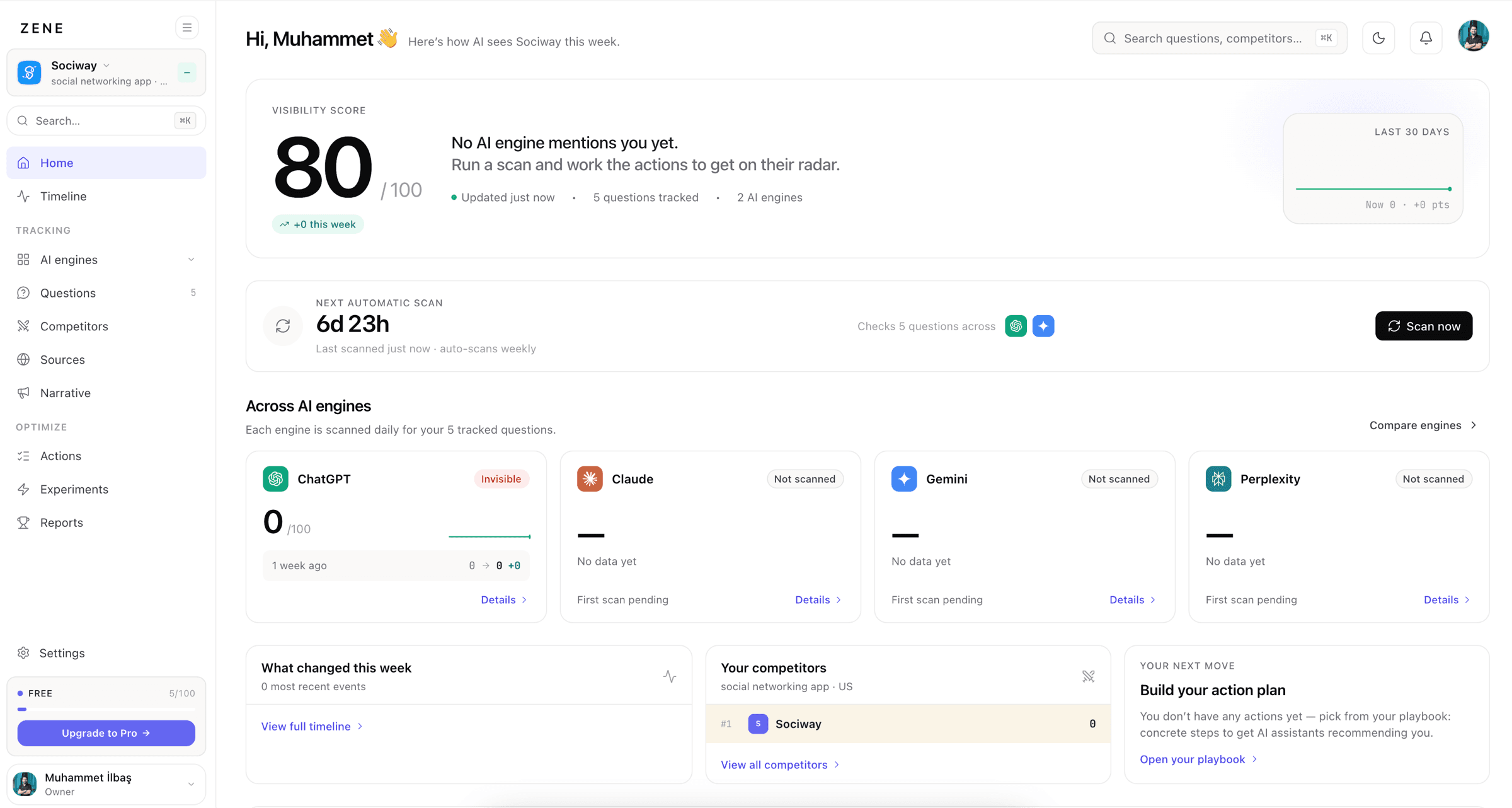
Zene dashboard: a brand's AI visibility score, the next automatic scan, and per-engine cards for ChatGPT, Claude, Gemini and Perplexity