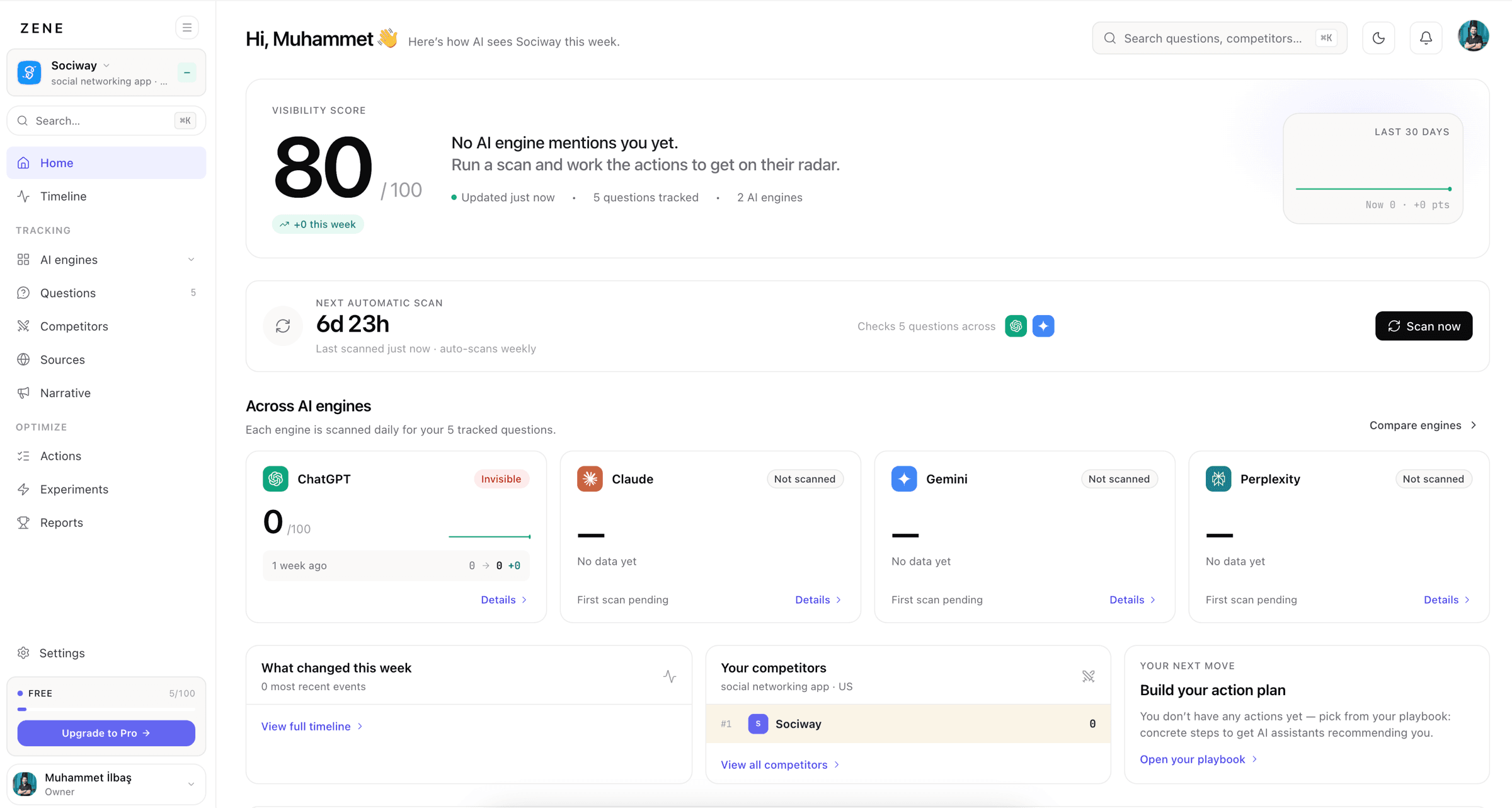
You built the app. It works. The people who found it rate it well. Then a prospect mentions they asked ChatGPT for "the best app for [exactly what you do]" - and got three competitors and a caveat. Not a hallucination, not bad luck: assistants recommend from evidence, and somewhere your evidence is failing. The failure is almost always mechanical and diagnosable - which is why this article is a diagnosis, not a pep talk. Twenty signals, five categories, in the order assistants weigh them. Run your own listing through the free checker as you read; it grades every signal below automatically.
Category 1: Listing quality - can an assistant take you seriously?
The store listing is the primary document about your app anywhere on the web, and assistants read it the way an editor reads a press release. The signals: a clear name within the 30-character display limit (longer gets truncated in the citations that feed AI answers); a substantial description - 1,000+ characters of real sentences, because a two-line description gives a language model nothing to summarize; five or more screenshots (visual completeness correlates with the listing-quality bar review sites apply); a recent update - within ~90 days reads as maintained, past a year reads as abandoned, and abandoned apps get quietly dropped from roundups and answers alike; release notes that say something; and a precise category, because "best X app" answers are assembled by category framing.
Category 2: AI answerability - does your text answer the question?
This is the category most listings fail without knowing it. An assistant answering "what's a good app for tracking shared expenses?" needs your description to contain, in some quotable form, "this app tracks shared expenses." The signals: an opening sentence that states what the app does and for whom - not "#1 award-winning", which models strip as unverifiable; use-case phrasing in natural language ("helps you…", "perfect for…") matching how questions are actually asked; no keyword stuffing - a word repeated eight times in a description reads as spam to a model summarizing meaning; and a scannable feature list, the structure summaries and listicles lift directly. Classic ASO keyword logic and this answerability logic sometimes pull in opposite directions - when they do, the tiebreak depends on where your users actually come from, but the stuffed version loses both games more often than it wins either.
Category 3: Reputation - do the numbers vouch for you?
Assistants can't try your app, so they trust the crowd's aggregate. Rating average: 4.4+ is where recommendations live; 3.8-4.4 earns hedged mentions; below that, a listing deters recommendation outright. Rating volume: the entry ticket. Under ~1,000 ratings an app reads as niche; under ~100, assistants have essentially no social proof to stand on, and the roundup writers whose articles feed AI answers won't include you either. Downloads (visible on Play): the same logic. If your volume is thin, this category outranks everything else on this page in priority - in-app review prompts at moments of success, shipped this week, compound for every future answer.
Category 4: Web presence - is there anything to cite?
When an assistant wants to verify or expand on a store listing, it reads the web - and finds either your citable footprint or nothing. The signals: a developer website declared on the listing and actually live (no website means no citable surface; a dead link is worse), an llms.txt handing crawlers a clean index, and structured data - ideally SoftwareApplication JSON-LD naming the app, its platforms and both store links, so the entity is machine-readable rather than inferred.
Ask an assistant for "the best app" without naming your phone, and it prefers apps it can hand to any asker. The signals: a verified listing on the other store - same app, same developer - and an identical name on both. A name that differs across stores splits your identity in training data; a single-platform app forfeits half the answers by default. When the other platform truly isn't on the roadmap, make your platform explicit everywhere so at least the evidence is coherent.
The diagnosis order
- Reputation floor first. If your rating base is two digits, nothing else moves answers much - start the review-prompt flywheel today.
- Then answerability. The description rewrite ships in an afternoon and is picked up by retrieval in days-to-weeks.
- Then web presence. Site, schema, llms.txt - a weekend of work that gives every engine something to cite.
- Then the listing polish and cross-store consistency. Screenshots, release notes, naming - real signals, smaller levers.
ChatGPT isn't ignoring your app. It's reading your evidence exactly as written - and somewhere, the evidence says "skip."
The takeaway
Every one of these twenty signals is public, checkable and fixable - which makes AI invisibility unusual among marketing problems: it comes with a to-do list. Run the free check to see your fails ranked, work them in the order above using the full playbook, and then verify the thing that actually matters - whether the engines name you - with the free engine audit.
Frequently asked questions
Why does ChatGPT recommend my competitors but not my app?
Because on the signals assistants can see, your competitors look like the safer answer. An assistant can't install either app - it compares public evidence: whose description states its purpose more quotably, whose rating base is deeper, whose listing looks maintained, who has review-site coverage to cite. Run both listings through the same 20-signal check; the gap is usually visible in minutes, and it's usually fixable - it's rarely about product quality.
Does a small number of ratings really keep my app out of AI answers?
It's one of the strongest suppressors. Assistants are trained on a web where 'best app' roundups, review sites and forum threads all key off visible traction. Below roughly 1,000 ratings an app reads as niche; below 100 it rarely surfaces at all, regardless of its average. The fix is unglamorous - in-app review prompts at moments of success, shipped consistently - which is exactly why starting early matters.
My app is iOS-only. Does that hurt AI recommendations?
Measurably. When someone asks 'best app for X' without naming a platform, assistants prefer apps they can recommend to anyone. A single-platform app forces the assistant to either caveat the answer or pick something else. If building for the other platform isn't feasible, mitigate: make your platform explicit in the description and ensure your website clearly presents the app as the iOS answer in its category.
How do I check my app's AI visibility for free?
Paste your App Store or Play Store link into Zene's free app AI visibility checker. It grades all 20 signals in this article - listing quality, AI answerability, reputation, web presence, cross-platform - deterministically from your public listing, no signup. Then run the engine audit (free on ChatGPT and Gemini, all five engines on Pro) to see whether the assistants actually name your app for your category's questions.
 Muhammet İLBAŞ 9 min