Every week, thousands of business owners search some version of "how do I add my business to ChatGPT" - expecting to find the AI equivalent of a Google Business Profile. A form. A listing to claim. A checkbox that says include me in the answers.
Here's the honest answer up front: it doesn't exist. There is no submission form, no business directory, no paid placement that inserts you into ChatGPT's organic recommendations. But that doesn't mean you're powerless - ChatGPT decides every day which businesses to name, and those decisions follow patterns you can deliberately influence. This is where its answers actually come from, the five things that effectively function as your "listing," and how to check whether any of it worked.
ChatGPT isn't a directory - it's a language model that composes answers from two sources. First, training data: the snapshot of the public web it learned from, where businesses that were widely and consistently written about became part of what it "knows." Second, live search: for current or local questions it searches the web mid-answer, reads a handful of pages, and quotes them. Neither pathway has an intake queue. You don't register with the model; you become legible to the web it reads. (The full mechanics are in how to get ChatGPT to recommend your brand - this piece is the business-owner's version.)
One nuance for product sellers: ChatGPT's shopping surfaces do lean on structured product data from the open web - clean feeds, schema, availability. That's the closest thing to a "submission" that exists, and we took it apart in
how ChatGPT picks products. For services and local businesses, no equivalent exists: it's all reputation and retrieval.
The five things that function as your listing
1. A website that says what you are, plainly
When ChatGPT searches, it needs one thing from your site: a sentence it can lift. "We're a family-run HVAC company serving the Denver metro since 2009, specializing in same-day furnace repair" is quotable. "Comfort, delivered" is not. Put the plain version - what you do, where, for whom, at what price range - on your homepage and about page, server-rendered, with Organization or LocalBusiness schema marking it up. And make sure the AI crawlers aren't blocked in your robots.txt - plenty of businesses are invisible for exactly that reason and never know it.
2. Consistent facts everywhere your business appears
Models trust what independent sources agree on. If your name, address, services and pricing read differently across your site, your Google Business Profile, Yelp, industry directories and social profiles, the model sees noise and hedges. The old local-SEO discipline of consistent NAP (name, address, phone) is now also AI hygiene: every listing you already have is a document an engine might read about you. Claim them, fix them, keep them saying the same thing.
When someone asks "best [your category] near me," the pages ChatGPT retrieves are rarely business homepages - they're review platforms and "best of" roundups. Which platform matters depends on what you sell: G2 and Capterra for software, TripAdvisor for hospitality, Yelp and Google reviews for local services. A steady stream of genuine, detailed reviews does double duty: it feeds the pages engines cite, and the review text itself teaches models how to describe you. We dug into the software version in review sites as AI citation engines.
4. Presence in the lists people already trust
Ask ChatGPT for recommendations in almost any category and the brands it names trace back to comparison articles, local guides and community threads. Those pages are the shelf. Getting into the credible "best X in Y" roundups for your niche - by pitching, by being genuinely notable, by being reviewed - is worth more than any amount of tinkering on your own site, because it's the pages engines already cite that decide the shortlist.
5. A Google Business Profile that feeds the ecosystem
ChatGPT doesn't read Google's index directly - but your Google Business Profile propagates to the maps platforms, aggregators and directories that AI assistants do read. And it matters directly for the other engine your buyers use: Google's Gemini and AI Mode are grounded in Google's own data, where your profile is a first-class citizen. Complete it properly - categories, hours, photos, services - and you've improved two AI surfaces with one hour of work. (Local businesses: the full playbook is in GEO for local business.)
What not to waste money on
- "Guaranteed ChatGPT placement" services. Nobody can guarantee an organic AI recommendation - you can't pay ChatGPT to recommend you, and anyone promising otherwise is selling certainty that doesn't exist.
- Keyword-stuffing your site "for AI." Models read like careful humans, not like 2009 Google. Clear beats dense, every time.
- One-time fixes. Answers change as models retrain and re-retrieve. This is a presence you maintain, not a box you tick.
One genuinely useful thirty-second version of "fixing your website": write the one sentence you want every AI to repeat about your business, and put it near the top of your homepage. Draft it here:
How to check whether it worked
Don't ask ChatGPT about your business by name - it'll politely describe you, which proves nothing. Ask the way customers do: "best [category] in [city]," "[service] near me," "alternatives to [the big competitor]." If you show up unprompted, you're on the shelf; if a rival shows up instead, you now know exactly whose sources to study. Do it across engines (they disagree more than you'd think) and re-check on a schedule, because a single answer is a coin flip, not a fact.
Try it on your brandSee whether ChatGPT - and the other four engines - recommend your business right now.
Type your brand name or domain - we'll line up the questions buyers ask about it.
The takeaway
You can't add your business to ChatGPT, and that's the good news - it means none of your competitors can either. What exists instead is a system that reads the public web and repeats what it finds credible. Make your site quotable, your facts consistent, your reviews real and your presence felt in the lists that already rank, and you become the business the answer reaches for - without ever filling in a form.
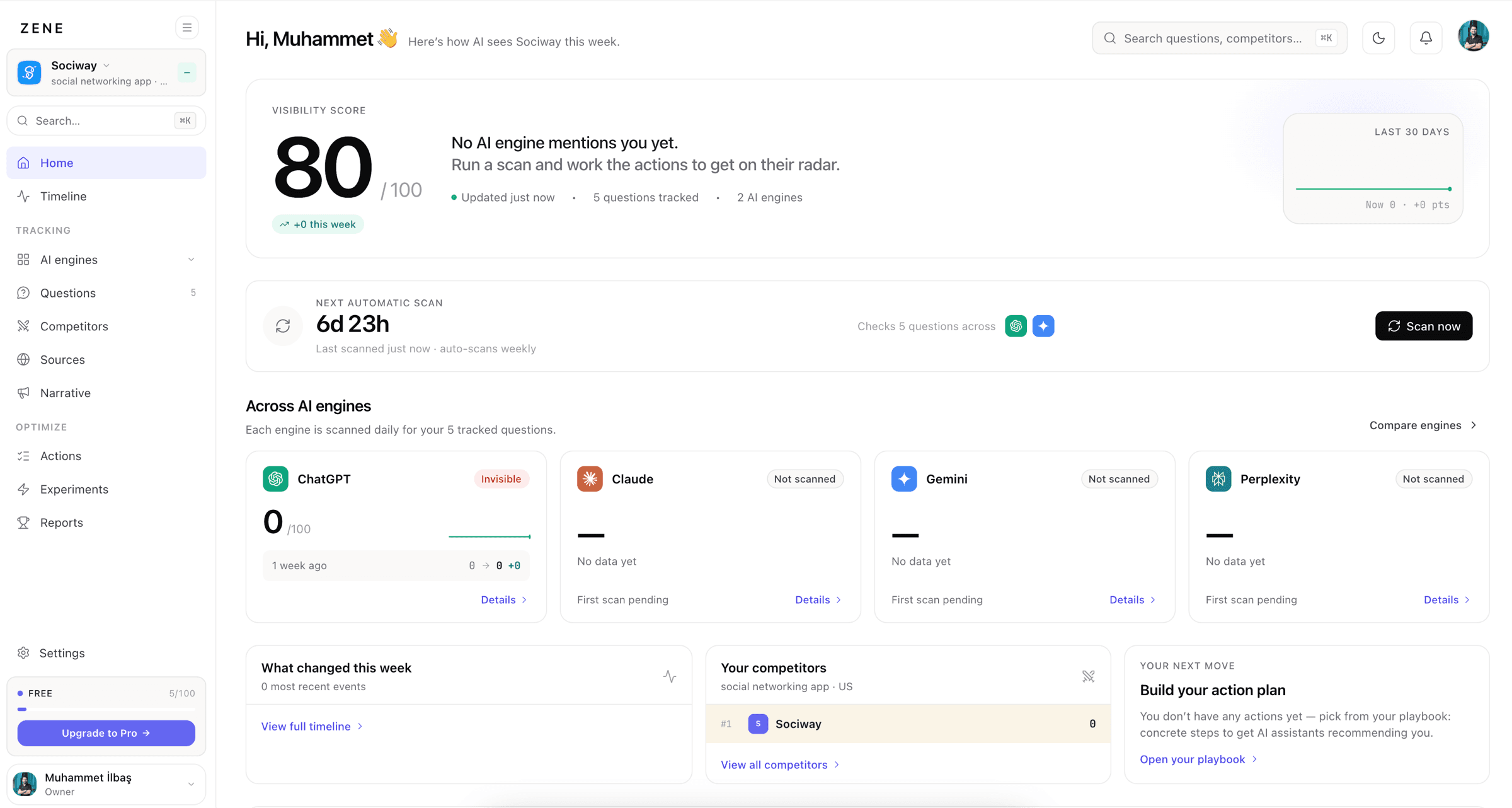
Want the baseline first? Run a free Zene scan - it asks the engines your real buyer questions and shows you exactly where you stand, and who's being recommended in your place.
Frequently asked questions
Can I submit my business to ChatGPT?
No. There is no submission form, business profile, directory or paid listing that puts your business into ChatGPT's organic answers. ChatGPT assembles recommendations from two places - what it learned about the web during training, and what it finds when it runs a live search mid-answer. The only way in is to be present and well-described in both: consistent facts about your business across the sites it reads, and a crawlable website that states plainly what you do, where, and for whom.
How much does it cost to be recommended by ChatGPT?
Organic ChatGPT recommendations can't be bought - there's no ad slot inside the recommendation itself and no fee that gets you named. The real costs are indirect: the time (or agency fees) it takes to clean up your listings, earn reviews, and publish pages worth citing. Be wary of anyone selling guaranteed ChatGPT placement; nobody can promise that.
Does my Google Business Profile affect ChatGPT?
Indirectly, and it's still worth doing. ChatGPT doesn't read Google's index directly, but a complete business profile feeds the wider ecosystem - maps platforms, directories, review sites, 'best of' articles - that AI assistants do read and cite. The same consistency work also helps Gemini directly, since Google's AI surfaces are grounded in Google's own index.
How long until ChatGPT knows my business?
On two clocks. When ChatGPT searches the web mid-answer, a new crawlable page or fresh directory presence can surface within days to weeks. Its trained memory is slower - it only updates when OpenAI ships a new model, so being 'known' without a search can take months. Start with the fast path: be findable and quotable when it looks.
 Muhammet İLBAŞ 9 min