"Does AI recommend my brand?" isn't one question - it's eight, because there are at least eight distinct engines doing the recommending, and they don't share a brain. ChatGPT can name your competitor while Perplexity names you; Google's AI Overview can ignore both. This is the field guide we wish existed when we started: every engine that matters in 2026, who's behind it, whether it reads the live web or speaks from memory, and the one lever that moves it.
Two mechanics decide everything below, so hold them in your head as you read. An engine either retrieves - searches the web mid-answer and quotes what it finds - or it answers from memory, the snapshot it took during training. Retrieval moves in weeks; memory moves only when the lab ships a new model. Most engines do both, and which one fires depends on how the question is phrased.
1. ChatGPT - OpenAI
The one everyone means when they say "AI." ChatGPT answers a broad question ("best project tool for a small team?") straight from memory, but switches to live search the moment a question feels current or specific - and when it searches, it cites. That dual nature is why two people get different answers from the same prompt.
How it picks who to name: from memory it leans on whatever was well-represented in training - established brands, heavily-reviewed categories, anything Reddit and comparison sites talked about a lot. When it searches, it pulls the pages that already rank and read cleanly.
Your lever: feed both clocks. Ship quotable comparison pages for the retrieval path, and build the third-party presence that the next training snapshot will absorb.
2. Google AI Overviews & AI Mode - Google
The highest-volume surface on this list by far, because it sits on top of regular Google searches that billions already run. The Overview is generated, grounded in Google's own index, and shows a handful of source links. Google's newer "AI Mode" is the full conversational version of the same thing.
How it picks who to name: heavily from pages that rank well in classic Google results - which is the one place your old SEO investment still pays directly into an AI answer. Structured, authoritative, well-linked pages get pulled in.
Your lever: the SEO fundamentals you already know, plus schema markup so Google can parse exactly what you are. If you rank on page one and still don't appear in the Overview, that's a quotability gap, not a ranking one.
3. Perplexity
The purest "answer engine" - it searches the web on essentially every query and shows numbered citations by default. Smaller reach than ChatGPT or Google, but disproportionately used by researchers, journalists and buyers in the comparison phase, which makes a mention here punch above its traffic.
How it picks who to name: it reads the top search results live and synthesises from them, so it's the most "winnable this month" engine on the list. We wrote a whole piece on how Perplexity picks its sources.
Your lever: get a clear, current page ranking for the exact question, and earn a spot in the third-party listicles Perplexity tends to cite. Because it always retrieves, changes show up fast.
4. Claude - Anthropic
Anthropic's assistant skews toward professional, technical and enterprise use, and it can search the web when a question needs current information. Lower consumer-shopping volume than ChatGPT, but the audience is exactly the high-intent, considered-purchase crowd a B2B brand wants.
How it picks who to name: from memory for general questions, drawing on the same well-documented, widely-discussed brands; from the live web when it searches. It rewards clear, accurate, well-structured source material.
Your lever: the same crawlable, quotable foundation - and don't block its crawler, which is the silent reason plenty of sites are invisible here.
5. Microsoft Copilot
Copilot is woven through Windows, Edge, Bing and Microsoft 365, so its reach is enormous even when nobody opens it on purpose. It's web-grounded and cites sources, drawing on Microsoft's search index plus an OpenAI model underneath.
How it picks who to name: close to the search-and-cite pattern - pages indexed by Bing that answer the question directly. Being absent from Bing's index (not just Google's) is a real and overlooked gap.
Your lever: make sure Bing actually indexes you (Bing Webmaster Tools), then the same quotable-content work carries over. More in how Copilot picks brands and sources.
6. Grok - xAI
Built into X (Twitter), Grok's edge is real-time awareness of what's being said right now, blending the live web with the conversation on the platform. That makes it unusually sensitive to current buzz, launches and sentiment.
How it picks who to name: the live web plus what people are actively posting - so being talked about on X, not just documented on your own site, carries weight here in a way it doesn't elsewhere.
Your lever: the public conversation. Launches, founders posting, customers tagging you - the social surface feeds this engine directly.
Easy to forget because it has no destination of its own - it lives inside WhatsApp, Instagram and Messenger, in front of an audience measured in billions. Web-grounded, conversational, and increasingly where casual "what should I buy / where should I go" questions get asked.
How it picks who to name: web retrieval for current questions, memory for general ones, with the same bias toward well-documented, widely-reviewed options.
Your lever: nothing Meta-specific yet - the cross-engine foundation covers it. Worth watching as it adds more commerce and local features.
The rest, in one breath
- DeepSeek, Mistral's Le Chat and other open or regional models - smaller reach, same mechanics. If your market is region-specific, check whether a local engine matters more than the US names.
- Vertical assistants baked into specific apps (shopping, travel, coding tools) - niche, but if one sits exactly where your buyers decide, it can outrank a general engine for you.
The pattern across all of them: retrieval engines (Perplexity, Copilot, AI Overviews) reward a clear page that ranks today; memory-leaning engines (ChatGPT, Claude, Gemini, Grok at rest) reward being the brand the whole web has already been documenting for months. You win the first with content, the second with presence - and you need both.
Why you can't just check one
Because they disagree, constantly, and for structural reasons - different indexes, different training cuts, different retrieval triggers. A brand can be the default answer in Perplexity and a no-show in ChatGPT in the same week. Checking one engine and assuming the rest match is the single most common mistake we see, and it's usually wrong in whichever direction costs you most.
It also drifts: the answer that names you today can drop you next week when a model updates or a competitor ships a better page. So the real job isn't a one-time audit - it's a baseline across every engine and an eye on the gaps, which is exactly the visibility score problem.
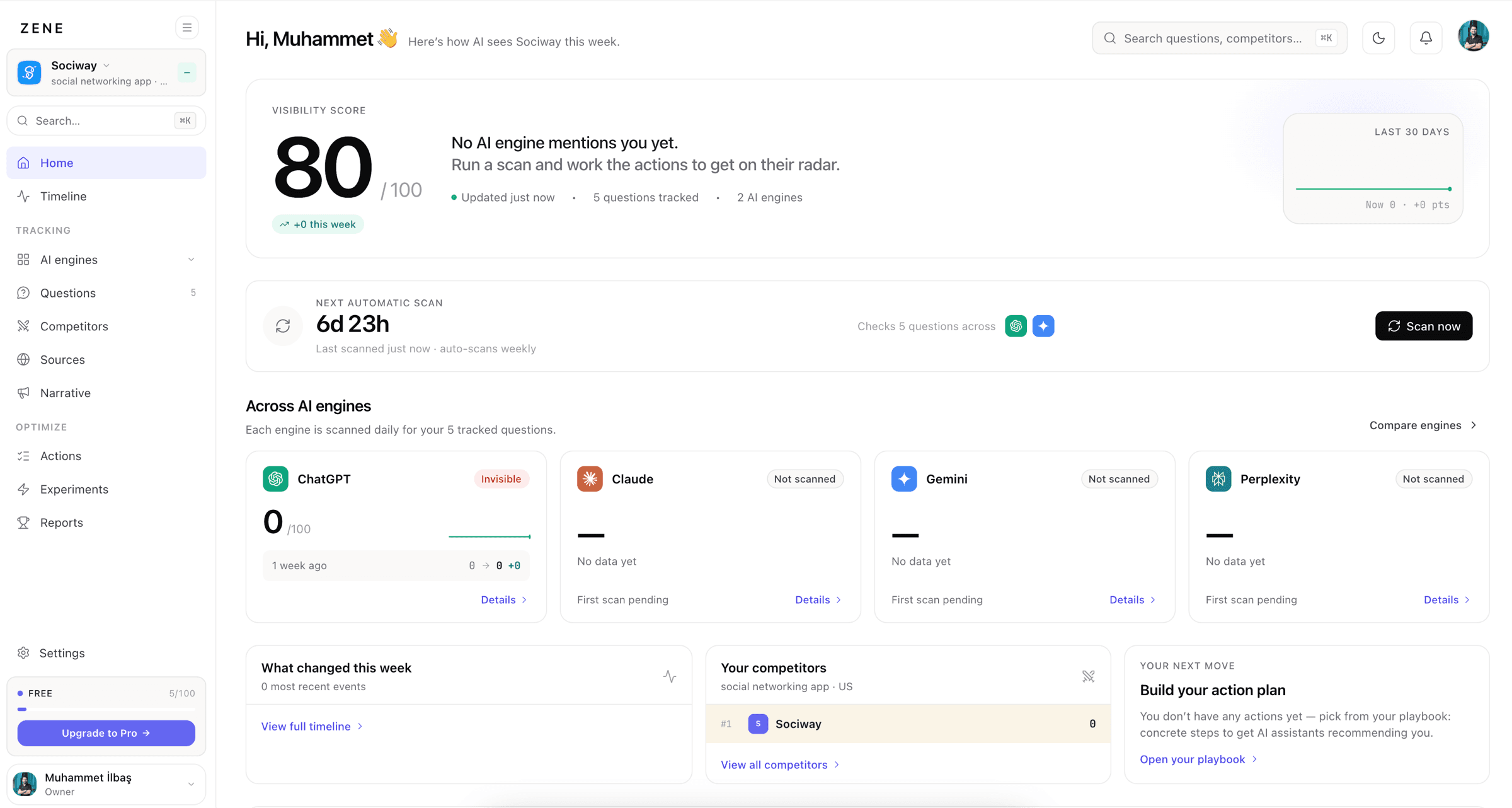
The fastest way to use this guide is to see where you actually stand on each engine right now. A free Zene audit runs the same question across ChatGPT and Gemini at once (all five engines on Pro) and shows you, engine by engine, who they name - and where the gap is.
Frequently asked questions
Which AI engines recommend brands to users?
The ones your buyers actually use: ChatGPT (OpenAI), Google's Gemini app and AI Overviews, Perplexity, Claude (Anthropic), Microsoft Copilot and Grok (xAI), plus Meta AI inside WhatsApp and Instagram. Each can name a brand inside a generated answer, and each decides who to name differently - some search the live web and cite sources, others speak from what they memorised in training.
Do all AI engines search the web before answering?
No. Perplexity and Copilot almost always search and cite their sources. ChatGPT, Gemini, Claude and Grok can search but will often answer from memory for a broad question like "what's the best CRM?". Whether an engine searches changes how fast you can influence its answer - retrieval moves in weeks, memory in model-update cycles.
How do I get recommended across every AI engine at once?
There's no single switch. The shared foundation works everywhere: a crawlable site that states plainly what you are and who you're for, presence on the third-party surfaces models learn from (reviews, comparisons, community threads), and structured, quotable pages. After that, the per-engine levers in this guide do the fine-tuning. Tracking all of them in one place tells you which engine still has a gap.
 Muhammet İLBAŞ 9 min